UN aid chief Tom Fletcher: Preventing World War III must be a priority
UN humanitarian chief Tom Fletcher has issued a stark warning that World War III is a genuine concern, urging immediate efforts to de-escalate. In an interview from his office at the UN building in New York, Mr Fletcher said he worried that humanity is at a precipice. "I worry we are losing control. Humans are losing control of weapons, of AI, of the climate and increasingly of the global economy, which is being placed on a war footing," he said.
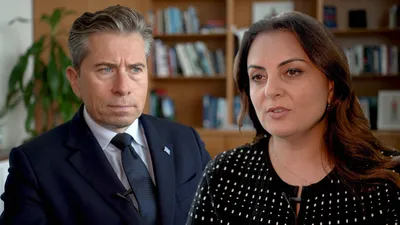
UN humanitarian chief Tom Fletcher has issued a stark warning that World War III is a genuine concern, urging immediate efforts to de-escalate.
In an interview from his office at the UN building in New York, Mr Fletcher said he worried that humanity is at a precipice.
"I worry we are losing control. Humans are losing control of weapons, of AI, of the climate and increasingly of the global economy, which is being placed on a war footing," he said.
Mr Fletcher, the UN Under Secretary General for Humanitarian Affairs and Emergency Relief Co-ordinator (Ocha), added that these forces and “different choke points propel us towards a much bigger war”.
When asked if this meant a world war, he responded “our biggest job in the coming year, the biggest job for the next [UN] secretary general is preventing World War III".
Some progress made, more needed
While the High-Level Debate at the UN General Assembly may seem far removed for many outside the orbit of the UN, the reality is that what happens in New York in September matters for people around the world - especially the most vulnerable who need aid, support or protection.
Mr Fletcher spent the week going from one meeting to the next, seeking to change dynamics - especially in protracted conflicts.
Understanding that the resources of time and attention are scarce, Mr Fletcher set out the week with 10 direct requests from countries, in an effort to save 11 million people. Among the requests is allowing female humanitarians to work in Afghanistan, to release UN workers detained in Yemen, and to allow humanitarian work to resume in both countries.
Asked how far he had got in achieving his 10 targets, he said: “I'd give us two or three out of 10, but those are the kind of odds no one else will take, and so the UN should take them”.
He added that progress was made on “getting a coalition together on Afghanistan to really insist that female humanitarians can work”. Other areas of progress were on the Democratic Republic of the Congo and getting some support for access to areas affected by the Ebola crisis . One important issue is keeping the Adre border crossing open between Chad and Sudan, which Mr Fletcher sounded optimistic about, saying “we think it will stay open.”
Mr Fletcher also sees potential progress on Palestine, where he said a coalition including the Board of Peace was forming to address humanitarian efforts ahead of winter.
“The big focus was on our winter plan, helping 2.1 million people through what will be a grim winter”, he said.
That plan includes getting 90,000 family tents into Gaza in the coming weeks. He called the co-ordination with the Board of Peace “significant”, joking that he spends more time on the phone to the Board of Peace than to his family. "I talk to them every day," he said.
He went on to say that “there's a perception that somehow the Board of Peace was invented as an alternative UN. I don't see any of that. What I do see is a very practical day-to-day discussion around the humanitarian supplies that we need to get in, and there's been improvements”.
Mr Fletcher said that when he took on his role, 92 per cent of Gaza's residents went to bed hungry. The number now is less than half that. Progress, but he said it was still an unacceptable level.
“We have to demonstrate that survival alone for people in Gaza - that's not a win," he said.
Dealing with funding cuts and working with US
Mr Fletcher took the helm at Ocha during one of the most difficult times for the international system - with severe polarisation on the world stage, near paralysis of the UN Security Council and major cuts in overseas aid.
Yet he says there is no choice but to make the best of things. He called the funding gap for humanitarian work “massive”.
While his predecessors co-ordinated roughly $50 billion in humanitarian response annually, he only has about $12 billion to work with. Even after prioritising those in greatest need and facing the most severe conditions, he needs to secure $23 billion.
Mr Fletcher was one of the most vocal humanitarian actors calling on US President Donald Trump last year not to cut funding for international aid. The Trump administration has closed USAID and US humanitarian funding has dropped sharply under his administration, though the US remains the biggest international donor.
Still, Mr Fletcher said: “they are saving tens of millions of lives. So that's great in itself”.
However, Mr Fletcher does not just look to the US for money. “On almost all of my 10 objectives, the Americans can play a key role in cajoling and persuading”, as part of the wider political efforts to change behaviour of other actors.
“I don't have carrots and sticks, they've got plenty of both”, he said.
A third element concerns US support for international aid. Mr Fletcher said that if Mr Trump wants the US to do less, “someone else is going to have to do it”.
He is seeking US backing so UN agencies can “go the places they [the US] don't want to go”, citing the Ebola response as one example. But he said this effort was still “a work in progress”.
“We're out there trying to manage that crisis on behalf of the world, so we need them to work with us to rebuild up the response to those crises, so that we can actually deliver," he said.
He added “the good news is that the Americans are back in as the largest donor, and that we have a much higher proportion of the funding raised going to the co-ordinated plan.”
The call now is for others to support that plan that is much more efficient than previous years. He added “$23 billion is less than 1 per cent of what the world is spending on arms right now, including the drones that are being used and tested in the atrocities labs of South Sudan, Sudan, Somalia, Ukraine, Gaza, and Lebanon against civilians”.
In addition to the challenges of conflicts and funding, there is a rising threat from drones, particularly AI-powered drones , Mr Fletcher said.
He saw them firsthand on his visit to Ukraine , describing them as “absolutely terrifying, chilling”, adding “I really worry these drones are getting cheaper”. He warned that “these weapons won't stay in one place, but no one can think that they are immune to that”.
'We're completely imperfect'
The UN is preparing for a major change, as Secretary General Antonio Guterres's term ends at the end of the year. Mr Fletcher expects a woman will take on the role, which would be a historic first. He would not speculate further on who the next secretary general may be.
Whoever it is, they will have their work cut out for them. Mr Fletcher repeated his stance that there is no better institution for global governance than the UN. He stated: “We're completely imperfect. We know we have all sorts of flaws. The Security Council is paralysed. We can be much more efficient, and the reform programme Guterres has put in place is leading us in that direction”.
He added “we've got to be doing that mediation. We've got to be taking those risks and building their coalitions”. He went on to say that the first year for the new secretary general would be “make or break".
He made several references to concerns about the Security Council, saying “it doesn't know yet whether it wants a secretary or a general.. They won't agree on everything. They never have done, but they can at least disagree on a bit less”.
Mr Fletcher went on to say that “the decisions that we fail to make here have real-world implications for the public in the UAE, in the UK, in Europe."
Despite the many concerns around conflicts and especially in the Middle East, officials at the UN this week referenced Syria as a place where there are positive developments. Asked what gives him hope , Mr Fletcher said “there are places where the situation is getting better.. I had a great meeting on Syria yesterday, including with President [Ahmad] Al Shara, and we've come a long way”.
His assessment is that Syria is a “success story”, despite being “fragile”. Syria has set a target of clearing mines and camps for displaced people.
“The ‘No Mines, No Camps’ initiative is a way to clear the obstacles, so it's easier for people to go home and rebuild their lives again," he said.
Mr Fletcher went on to say that he gets energy “from when I'm out on the ground in the field with the communities who are really up against this, and with humanitarians who are far away from these halls and are not sat here in a suit and tie doing media interviews, but are out there every day risking their lives and changing people's lives”.
He acknowledged that “if they can do it, then the rest of us can show a bit more courage too”.