From flood disaster to climate warning, Shah makes the Himalayas his UN message
Nepal’s prime minister calls for a Himalayan climate-resilience mechanism, more grant-based finance, and stronger regional early-warning systems as climate extremes threaten mountain communities.
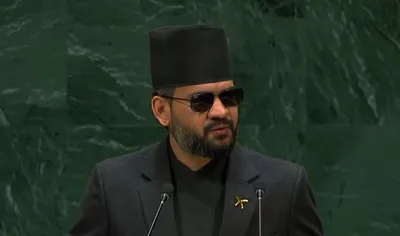
Prime Minister Balendra Shah used his address to the United Nations General Assembly on Friday to warn that the devastating Bhotekoshi-Trishuli floods were a glimpse of the growing climate risks facing the Himalayas.
Speaking four weeks after the disaster, which he said had been likened to a “Himalayan Tsunami”, Shah described the floods as more than a national tragedy.
“The Bhotekoshi-Trishuli disaster was not just a local tragedy; it was a warning to the world,” Shah told the 81st session of the General Assembly. “And I ask you today: have we really heard that warning?”
“I come before you from Nepal, a distant country in the Himalayas, carrying a close warning for humanity,” he said.
The disaster left families waiting for missing relatives, communities searching through mud and rock for bodies, and roads, bridges, schools, homes and livelihoods swept away within minutes, Shah said.
“A warming climate is destabilising the fragile Himalayan ecology,” he said, pointing to melting permafrost, unstable mountain slopes, ice-rock avalanches, floods and landslides as interconnected risks.
The devastation spread across the Nepal-China border and the floodwaters continued downstream towards India, he said, underscoring the need for cross-border cooperation.
“Climate change does not recognise borders,” Shah said. “Glaciers and floods do not travel with a visa stamped on passports.”
Nepal contributes less than 0.1 percent of global greenhouse-gas emissions, Shah said, yet its glaciers are retreating, mountain slopes are becoming less stable and rivers increasingly unpredictable.
Every major disaster risks wiping out years of development, he said.
“For Nepal, climate catastrophe is not just a humanitarian event, but a development emergency.”
Citing the impact of the Bhotekoshi disaster, Shah said Nepal had suffered at least 1,400 confirmed deaths and more than 6,000 people remained missing. Rapid assessments had put physical recovery needs at about 10 percent of GDP, he said.
He called for greater international support for recovery and reconstruction, arguing that vulnerable countries should not have to take on more debt to repair climate-related damage.
“When a climate-driven disaster destroys the infrastructure of a poor country, the answer cannot simply be another mega loan or a patchwork of small grants,” Shah said. “We need adequate grant-based support from the world.”
He said existing climate-finance mechanisms, including the Loss and Damage Fund and the Global Environment Facility, remained inadequate and called for simpler and faster access to funding.
“When the house is burning, we do not ask the family to complete fifty forms,” Shah said. “We act.”
Shah proposed a Himalayan Climate Resilience Mechanism, led by Nepal, India and China, to strengthen the region’s ability to anticipate and respond to climate-related disasters.
The proposed mechanism would facilitate the sharing of satellite data and expertise, monitoring of dangerous glacial lakes, stronger joint early-warning systems and coordinated cross-border disaster response.
The Himalayas, Shah said, should become a “laboratory of international cooperation” rather than a region where critical information remains fragmented.
The Hindu Kush Himalaya is home to nearly two billion people, he said, and its mountains provide water, ecosystems, agriculture and livelihoods far beyond Nepal.
“The Himalayas are not peripheral to the planet. They are part of the planet’s life-support system,” he said.
Shah also highlighted Nepal’s efforts to strengthen its own climate resilience, saying forests now cover nearly half the country and that Nepal was expanding hydropower, electric mobility and local climate adaptation.
But Nepal could not build resilience alone, he said.
Shah urged countries to uphold the principle of common but differentiated responsibilities and respective capabilities under the UN climate framework, arguing that those with greater historical responsibility for emissions and greater capacity to respond should do more.
“Climate justice cannot just remain a beautiful phrase in a United Nations document,” he said.
He also called for a shift from disaster response to preparedness, saying the changing climate was making old assumptions about risk increasingly unreliable.
“Our baselines are no longer relevant,” Shah said. “And we must move from ad hoc responses to a culture of preparedness.”
He called for greater investment in resilient infrastructure, insurance, innovation and early-warning systems, as well as efforts to reduce fossil-fuel dependence.