A diplomatic split screen as Trump and Xi meet
Trump-Xi talks in Washington highlight questions over the UN’s influence amid financial strain and global conflicts.
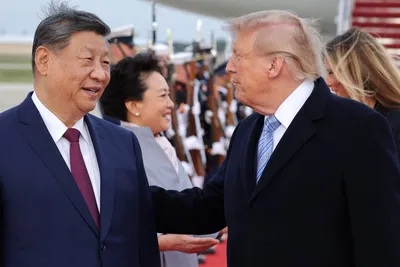
While world leaders gather at the United Nations for theirannual diplomatic ritual, the two biggest power brokers in global politics willsit down in a different venue on Thursday: the White House.
US President Donald Trump and Chinese leaderXi Jinping will meet for the second time this year, hoping to keep the world’smost consequential bilateral relationship steady as both leaders grapple with ahost of domesticand global issues.
The split-screen moment highlights an existential questionfor the UN: does the world body, established after the calamity of two worldwars, still matter?
While UN delegates discuss “multilateralism” and hold panelson the world’s conflicts, Trump and Xi – what the US president calls the “G2” –will talk AI, trade and defense.
“It’s pretty notable that Xi Jinping is coming to Washingtonin the same week as the General Assembly, but does not feel bothered to come upto New York,” said Richard Gowan of theInternational Crisis Group.
“I think a lot of people will say, ‘Where is the real centerof decision-making?’“
Xi rarely travels to New York for the General Assembly.
The questions about the UN’s roleare hardly new, but have acquired fresh urgency as the organization struggleswith deep financial problems, divisions among major powers and limitedinfluence over conflicts from Ukraine to the MiddleEast.
Those concerns have gained new relevance since Trump’sreturn to office last year. The US leader has pulled the US out of dozens of UNagencies and slashed Washington’s budgetarycontributions to the organization, pushing it to the brink of bankruptcy.
In his speech on Tuesday, Trump accused the UN of “imposingthe far-left agenda of globalist bureaucrats who nobody ever elected.”
The UN has a persistent budget shortfall,forcing it to cut the budget of its Secretariat by 9.2% for 2026. It laid offthousands of staff, sent peacekeepers home and cut back on humanitarian andhuman rights work.
The United States, which has for years withheld much of itsdues, is part of that problem.
The Trump administration last week paid $725 million for theregular budget, preserving its vote at the assembly, but still owes $1.3billion to the regular budget and $2.9 billion for peacekeeping operations, theUN said.
The organization’s problems extendbeyond money, however.
Gridlock has long defined the UN Security Council, wherefive veto powers including China, Russia and the US rarely agree on anythingsubstantive.
“There are two main challenges that the UN faces today: thefirst is its dire financial situation,” said Eugene Chen, a former UN official.
“This is linked to a second, broader, challenge – the factthat member states no longer agree on what the form or function of the UN ought to beat a timeof mounting global challenges,” he said.
Outgoing Secretary-General Antonio Guterres launched areform task force last year, known as UN80 which seeks to cut costs, removeduplication, move jobs to locations cheaper than New York and Geneva andimprove efficiency.
It includes a 21% reduction in posts at the Secretariat anda review of more than 600 series of mandated Secretary-General’s reports,aiming to reduce reporting by about 700,000 words in 2026.
Unlike in 2025, Trump did not use his Tuesday speech tocomplain about escalators or teleprompters and largely stuck to a script thatfocused on defending his record in the war with Iran and on the US economy.
Still, he inveighed against the “craven hypocrites” of the UN’sHuman Rights Council who “want America to open ourborders to gangs and criminals from the world ’ s most dangerous places,” and zeroed in on UNESCO, saying “theseglobalists are actively destroying the greatest cultures and most extraordinaryheritage in history.”
The UN has defended culture and education agency UNESCO’swork as “unanimously acclaimed by major specialized organizations,” and theHuman Rights Council as playing “a veryimportant role in the promotion and protection of human rights worldwide.”
Xi has sought to capitalize on Trump’s often bellicoserhetoric by presenting China as areliable partner on the global stage, especially fordeveloping nations, and by using the UN as a platform to advance that message.
For all the criticism of the UN, its annual meeting remainsa forum for high-volume diplomacy. This week, member states planned more than1,000 bilateral meetings, according to UN data.
Iran’s Foreign Minister Abbas Araqchi and US envoys SteveWitkoff and Jared Kushner communicated through mediators on the sidelines onTuesday, the first such contacts since an interim ceasefire agreement collapsed inJuly.
The European Union’s foreign policychief Kaja Kallas told reporters the UN remained relevant, but she toocriticized the organization for being “paralyzed when itcomes to preventing or ending conflicts.”
Ukrainian leader Volodymyr Zelenskiy used the venue to holdtalks with Trump on ending the war with Russia, including a potential ceasefireon energy-related targets.
He was asked by a journalist whether years of meetings atthe UN have brought any concrete results. He answeredin English: “Today it helps us to meet. Maybe it’s not too much, but it’ssomething.”