Beware Beijing bearing gifts as Xi visits America’s dealmaker-in-chief
Access to American markets must come with tough, but fair, questions.
 UNBOTHERED $UNB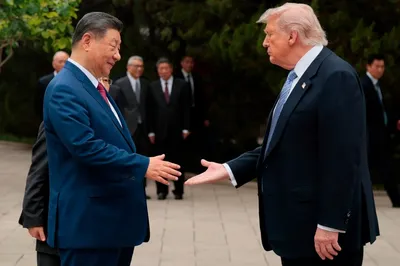
Chinese President Xi Jinping comes to Washington this week, at a time when relations between the U.S. and China are in flux. Beyond the warm handshakes, hugs and polite photos, there are palpable tensions between the world’s two largest economies. Trade and tariffs are front and center. But no less important is the systematic scrutiny of Chinese firms operating in the U.S. From servers to networking equipment to cooling systems to data centers, Chinese-manufactured components are embedded throughout American digital infrastructure.
More broadly, there is significant Chinese penetration — and in many cases domination — of key American industries, including ports, cars, hospitals, supply chains, rare-earth minerals and the grid itself. This proliferation has accelerated the regulatory reactions of the Department of Defense, Department of Commerce and the Federal Communications Commission, and the imposition of sanctions on several categories of products from China.
Amid this climate, the Trump-Xi Summit still holds promise; the reality is that China and the U.S. need each other more than they care to admit. Even as fierce economic competitors, the world’s two largest economies are conjoined by trade, investment, service and supply chain bonds that are difficult to decouple. Reports are that Xi will arrive in the U.S. accompanied by a large delegation of Chinese business leaders ready to make deals.
In advance, China has been buying substantial amounts of American agricultural products. American farmers surely want to sell more soybeans to China, and other industries are anxious to penetrate the vast Chinese market if allowed. But the trade imbalance is hard to ignore. Chinese companies have been both successful and savvy in leveraging an open U.S. market to their considerable advantage. Their uncanny ability to meet the needs of the market with affordable, innovative and indispensable products must be admired.
Cheap Chinese drones have helped American farmers to inspect crops and first responders to survey disasters. Chinese telecom equipment offered affordable infrastructure alternatives to U.S. providers. Chinese-made batteries, solar panels and industrial inputs have accelerated new technologies, and popular apps have attracted millions of ordinary American users who just cannot get enough. And inexpensive manufacturing opportunities in China have helped countless American companies, large and small, to lower costs and margins.
Suppliers have been less expensive, factories have been more efficient, and technologies have been more innovative The U.S. did not arrive at this point overnight. Years — in fact, decades — of permissive trade and investment policies by both Democratic and Republican administrations have contributed to the current state of affairs. Remedying, repairing or replacing these policies will take time, but is accelerating under the Trump administration.
The shift from enablement to enforcement of new regulations is happening as we speak. And that brings us to the larger issue of trust. This administration no longer treats Chinese commercial activity as merely a question of trade. Increasingly, it is viewed through the lenses of security, ownership, control, data, infrastructure and access. The FCC's covered list, created pursuant to federal law, identifies communications equipment and services deemed to pose an unacceptable risk to national security or the security and safety of Americans.
Huawei, ZTE, Hytera, Hikvision and Dahua have long appeared on it. More recently, the list has expanded to cover categories of foreign-produced drones and certain foreign-produced routers. The FCC also has adopted rules restricting authorization, marketing and importation of covered equipment. The Pentagon operates under a different statute and for a different purpose. Its Section 1260H list identifies companies that the Department of Defense determines are Chinese military companies operating directly or indirectly in the United States.
The government describes the list as part of its effort to address China’s military-civil fusion strategy, through which ostensibly civilian technology and commercial capabilities may contribute to military modernization. The Commerce Department maintains yet another regime. Its Entity List restricts exports, reexports and transfers involving designated entities. In 2025, Commerce expanded those restrictions to reach certain affiliates owned 50 percent or more by listed companies.
In other words, Washington has moved beyond looking merely at the name on the door — ownership matters too. Then there is the Committee on Foreign Investment in the United States, export controls, outbound investment restrictions and Treasury sanctions. These programs are not interchangeable, and being placed on one government list does not necessarily mean that a company is “sanctioned.” The legal consequences differ considerably.
But together they reveal something larger. The era of automatic access is over, which may be the most important message for the Chinese business leaders accompanying Xi on his visit. America remains one of the most attractive markets in the world, with deep capital markets, sophisticated consumers, world-class research institutions, enormous purchasing power and a legal system that gives foreign companies significant rights and protections.
CFIUS itself describes its mission as protecting national security while preserving America’s attractiveness to foreign investment. But access to American markets must come with tough, but fair, questions. Who owns the company? Who ultimately controls it? Where does the data go? What relationship does the company have with the Chinese government or military? Can American regulators obtain truthful information about its operations?
And perhaps most important, would an American company receive comparable treatment in China? If these basic questions cannot be answered on a company-by-company basis, to the satisfaction of U.S. law and American officials, it does not matter how good the deals are that Chinese business leaders come to propose. The Chinese must ensure that they will abide by a few fundamental principles: namely, transparency, reciprocity, security, standards and compliance.
None of this requires the U.S. and China to stop doing business together. Nor does it erase the benefits that Chinese goods, investment and manufacturing have brought to American consumers and companies. But it does mean that the relationship has indelibly changed and is in the process of being rebalanced. And that is good for both nations. Adonis Hoffman served in senior legal roles at the Federal Communications Commission and in the U.S.
House of Representatives, where he was counsel to the House Foreign Affairs Committee.