Trump’s threat to annihilate Iran to UN general assembly is stunning, even for him
US president may have upstaged the ghost of Soviet leader Khrushchev by musing destruction of fellow member state Donald Trump has a habit of discomfiting delegates to the United Nations general assembly. But this year, he may have upstaged the ghost of former Soviet leader Nikita Khrushchev by openly contemplating the annihilation of a fellow UN member state. Eleven minutes into a 40-minute address, the US president announced he had “a big decision to make” over Iran, which has staged a much more determined resistance than Trump anticipated when he decided to go to war against the country in February. Continue reading...
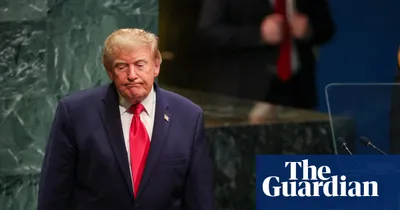
US president may have upstaged the ghost of Soviet leader Khrushchev by musing destruction of fellow member state
Donald Trump has a habit of discomfiting delegates to the United Nations general assembly. But this year, he may have upstaged the ghost of former Soviet leader Nikita Khrushchev by openly contemplating the annihilation of a fellow UN member state.
Eleven minutes into a 40-minute address, the US president announced he had “a big decision to make” over Iran , which has staged a much more determined resistance than Trump anticipated when he decided to go to war against the country in February.
“Will a deal be made with Iran that lets them rebuild, and create a far greater country than it ever was before?” he asked. “Or do I annihilate the Islamic Republic and do it quickly, never giving them a chance to kill and destroy people and countries again? Do I drive them into hell with no chance of survival and no hope of future greatness or generations?”
Possibly not since Khrushchev, the late Soviet leader, brandished his shoe and allegedly banged it on a desk in 1960 in protest at a fellow delegate’s speech has the annual gathering witnessed such a display of bellicosity from a superpower leader.
The world may have become inured to Trump’s dire threats to send Iran “to the stone age” or end its civilization – so often have they been issued, only to sometimes be followed by a ceasefire or negotiations. But hearing them voiced in a forum created in the aftermath of the second world war, with the explicit aim of preventing future conflicts, was disconcerting.
Iran was the focal point of much of Trump’s speech, which began with a catalogue of familiar boasts of his supposed achievements that seemed better fitted to a domestic audience.
Whether or not the latest threat should be taken literally, little of what he said about Iran seemed reassuring. He appeared to play fast and loose with the facts, consciously or otherwise.
The US president twice incorrectly asserted that the theocratic regime had held power for 51 years. In fact, the Islamic revolution that toppled the pro-western former Shah, Mohammad Reza Pahlavi, and installed the current regime happened 47 years ago, in 1979.
Trump also cited apparently inflated figures for the number of Iranians killed in anti-government protests last January, weeks before the war. “The same regime slaughtered over 72,000 of its citizens this year,” he said, in support of his oft-stated declaration that Iran should never be permitted to acquire nuclear weapons.
No definitive death toll has been established. But previous estimates of people killed in the brutal crushing of January’s demonstrations – even including those previously stated by Trump himself – have been much lower.
The ominous rhetoric was not limited to Iran.
Members of the Cuban delegation were seen leaving the hall as he predicted the imminent collapse of the country’s communist regime, which has been struggling to cope with a food security and humanitarian crisis amid tightening US embargoes.
“It’s an absolutely failed state, it’s failing like never before, and it will fall,” Trump said. “Marco Rubio [the US secretary of state] is handling a negotiation. He’s deep into negotiations with Cuba. Let’s see what happens.”
US actions in Venezuela, where special forces last January seized the strongman president, Nicolás Maduro, and spirited him to New York to face drug-trafficking charges, was also cited as an ominous warning to other adversaries – as well as a vocal statement of how the administration would behave in Latin America, Washington’s supposed “back yard”, if it felt its interests threatened.
“Our actions in Venezuela are proof that the United States will no longer permit threats to America to gain a foothold anywhere in the western hemisphere, and, if necessary, we will use our unmatched military might to secure the vital national interests of the United States,” Trump declared.
He was brazenly unabashed in hailing a recent US oil deal with the interim Venezuelan president, Delcy Rodríguez, that he claimed put the US and Venezuela jointly in control of more than 60% of the world’s oil.
“It was perhaps the biggest deal ever made. To the victor belong the spoils – you’ve all heard that,” Trump said.
There was outright antipathy for the international criminal court, which Trump called an “out-of-control institution” and “an evil group of people”. “We will never allow US service members or anyone else to be investigated or given show trials by an anti-American tribunal with no jurisdiction over us,” he said.
Given his pugnacious stance towards US adversaries, it probably came as a relief to Washington’s traditional friends that Trump had relatively kind words for them. It was a far cry from his general assembly speech a year ago, when he warned European allies “your countries are all going to hell” because of immigration.
This time, in a pointed message, Trump praised Nato’s secretary general, Mark Rutte, as a “great leader” – a marked departure from his previous denunciations of the military alliance as “obsolete” and a “paper tiger”.
He lauded Denmark as “an incredible, beautiful country”, just days after announcing an agreement with it over Greenland, following prolonged tensions over the territory, which Trump had previously threatened to annex.
With that issue seemingly settled – at least for now – the president declared his intention to flex his muscles on a new battleground: artificial intelligence, or AI.
Echoing recent social media posts, Trump likened recent calls to slow its development, on the grounds that its rapid development poses an existential threat to humankind, as a “globalist scheme” hatched by the same forces he blamed for warnings of climate change, a premise he has long erroneously labelled a “hoax”.
Part of the answer, he said, was to change its name. Henceforth it would cease to be called “artificial” (“it makes it sound fake – and it’s not fake”) and would be called “super intelligence” in all US government documents.
“Welcome to the new world of super intelligence,” he said. “Let’s see if that goes. It’s much more accurate. Let’s see if I have any power. Maybe I do, maybe I don’t.”