MOEA increases forecast for UAV business
The Ministry of Economic Affairs has increased its forecast of Taiwan’s drone industry output to about NT$50 billion (US$1.57 billion) by 2030 from an earlier estimate of NT$40 billion, thanks to rapidly growing demand.Drones are emerging as important tools of modern combat and reshaping traditional
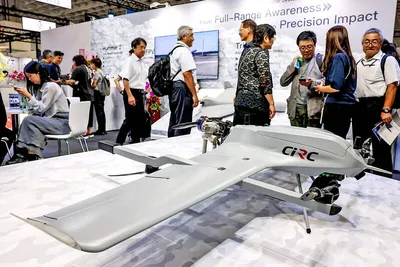
The Ministry of Economic Affairs has increased its forecast of Taiwan’s drone industry output to about NT$50 billion (US$1.57 billion) by 2030 from an earlier estimate of NT$40 billion, thanks to rapidly growing demand.
Drones are emerging as important tools of modern combat and reshaping traditional weapons production, driven by conflicts such as the Russian invasion of Ukraine, which show the changing nature of warfare, Minster of Economic Affairs Kung Ming-hsin (龔明鑫) said in an interview on Tuesday.
Taiwan has advantages in production efficiency and a comprehensive supply chain, while growing international demand for non-China supply chains gives it an opportunity to play a major role among democratic partners, Kung said.
Taiwan has seen rapid growth in exports of drones and related components from 2023 to last year, Kung said.
The government is promoting the drone industry through public sector and defense demand, he said. The ministry is supporting the sector through its uncrewed vehicle industry development program, covering market development, technology, testing sites and regulations, he said.
The Taiwan Excellence Drone International Business Opportunities Alliance has brought together more than 200 domestic companies to connect with overseas markets, Kung said.
Defense demand can provide more stable orders, allowing the industry’s small and medium-sized companies to invest in capacity expansion, he said.
Taiwan needs to expand capabilities in some components to buttress its self-reliance, including thermal imaging, satellite positioning and communications, Kung said.
The ministry encourages local companies to pursue international cooperation and deals, he said.
The first priority is to ensure “non-red” supply chains, while the longer-term goal is for Taiwan to be able to manufacture key components domestically, regardless of whether they are mass-produced, he said.
The government aims to raise domestic manufacturing capability for key drone technologies and components to 90 percent by 2030, from about 70 percent for small drones, 60 percent for medium-sized drones and 30 percent for large drones, Kung said.
Taiwan would continue to broaden its drone supply chain through industry alliances, expanded production capacity, testing sites and international cooperation, he said.
The goal is for Taiwan to play a key role in democratic supply chains and become “the center of Asia’s democratic drone supply chain,” Kung said.
MINIMAL EXPECTATIONS: Analysts think that the two sides are likely to aim for ‘status quo’-level agreements, maintaining civility, without major trade breakthroughs US Secretary of the Treasury Scott Bessent and Chinese Vice Premier He Lifeng (何立峰) were set to meet yesterday to try to set up potential agreements on artificial intelligence (AI), tariffs and critical minerals for a summit in Washington this week between US President Donald Trump and Chinese President Xi Jinping (習近平).
The meetings at JPMorgan Chase & Co’s headquarters in Manhattan, which included US Trade Representative Jamieson Greer, were due to start at about 10:30am on Sunday morning and were expected to run all day. Key topics would be the status of a US-China trade truce that is set to expire
MORE DATA CENTERS: Microsoft’s Taiwan-area general manager said the corporation is looking to add two more data centers in northern Taiwan over the next few years Microsoft Corp plans to double its data centers in Taiwan from two facilities to four, Microsoft Taiwan general manager Sean Pien (卞志祥) said yesterday. “Over the past two to three years, we have consistently seen demand outstrip supply, and we expect that situation to continue over the next two to three years,” Pien said on the sidelines of a news conference in Taipei.
The data center sites would mainly be in northern Taiwan to meet customer demand and reduce the risk of operational disruptions caused by a single event, he said, without saying their exact locations. Microsoft enabled the first phase of
SAFEGUARDING AI: Nvidia CEO Jensen Huang maintained a bullish stance despite concerns about artificial intelligence safety and growing calls for an industry slowdown Nvidia Corp chief executive officer Jensen Huang (黃仁勳) expects to sell twice as many chips in the coming year, fueled by the spread of artificial intelligence (AI) across different industries. AI is of great benefit to a variety of sectors, Huang told reporters on the sidelines of an event convened by King Charles III in Scotland on Thursday.
Nvidia is the top seller of AI accelerators, chips used to develop and run AI models. Huang is maintaining his bullish stance at a time when concerns are growing about AI. Industry leaders have discussed slowing down development of the technology over fears that
Berkshire Hathaway Inc has been synonymous with Warren Buffett. It falls to his oldest son, Howard Buffett, to keep the conglomerate’s “culture” alive. Friday’s announcement that Warren Buffett, 96, stepped down as chairman means the longtime investor would no longer have a management role at the company he took over in 1965, or be a regular sounding board for Greg Abel, who succeeded him as chief executive officer in January.
Howard Buffett, 71, is assuming a different role as non-executive chairman, focused on preserving Berkshire’s culture and values. It is the latest move in a years-long leadership transition. “This one is really about