American AI development ‘cannot separate itself from China’: Zheng Yongnian
China and the United States must prevent their AI competition from escalating into a cold war, a top Chinese policy adviser has warned, while asserting that a complete decoupling would be difficult. The remarks from Zheng Yongnian, a leading political scientist and dean of the school of public policy at the Chinese University of Hong Kong, Shenzhen, come ahead of the Xi-Trump summit in Washington, where artificial intelligence (AI) is expected to be among the top items on the agenda. Chinese...
China and the United States must prevent their AI competition from escalating into a cold war, a top Chinese policy adviser has warned, while asserting that a complete decoupling would be difficult.
The remarks from Zheng Yongnian, a leading political scientist and dean of the school of public policy at the Chinese University of Hong Kong, Shenzhen, come ahead of the Xi-Trump summit in Washington, where artificial intelligence (AI) is expected to be among the top items on the agenda.
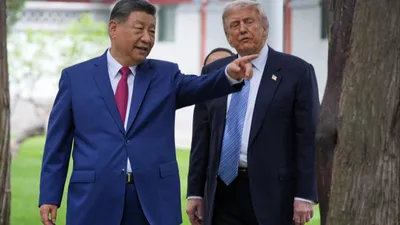
Chinese leader Xi Jinping received a rare personal welcome from US President Donald Trump as he landed in Washington to begin his first state visit to the country since 2015. Their summit talks are expected to be steered by a desire to find common ground while managing risks as rivalry intensifies, with AI and its governance at the forefront.
According to Zheng, existing rules on the emerging technology are shaped by “sheer strength” and China’s role in AI development by the US remains “indispensable”.
He also rejected claims that the second face-to-face meeting between the two leaders this year was merely symbolic.
“Many issues require consensus between the leaders first before the bureaucracies on both sides can push them forward … so many major decisions simply cannot be made at the bureaucratic level,” Zheng said in an interview.
Xi’s trip is aimed at building on his May summit with Trump in Beijing, where both sides agreed to reframe their ties around “constructive strategic stability” to properly manage conflicts and keep relations between the world’s top two powers from derailing.
But tensions continue to mount, especially around AI, as China quickly narrows the gap with the US, the early market leader.
The heads-of-state talks at the White House come just days after the two sides finally agreed on an AI dialogue framework, a long overdue outcome from the May summit, following hours-long negotiations in New York led by US Treasury Secretary Scott Bessent and Chinese Vice-Premier He Lifeng.
According to Bessent, the US has proposed a new “notification mechanism” to address high-level AI incidents that could affect national security, while seeking “a shared vision of common goals and common threats”.
Zheng said that neither the US nor China could manage AI risks alone – saying that the technology posed a far greater risk than nuclear weapons. While nuclear arms sat idle in silos under global oversight, AI was evolving rapidly in a regulatory vacuum, he cautioned.
“Cooperation is essential to build an international framework … We can’t have two separate systems – a US one and a China one,” he said.
“If that happens, it will devolve into a US-Soviet style [Cold War] dynamic which would be very, very terrible.”
But differences already exist and the US-China AI rivalry is fracturing into two distinct camps. The US favours a high-cost AI model catering strictly to developed, wealthy economies, as underlined by the Trump administration’s Pax Silica initiative to secure semiconductor and critical mineral supply chains and cut reliance on China.
Beijing, however, has championed an open-source, mass-market approach that aims to offer low-cost, accessible technology tailored to developing nations across the Global South.
Nevertheless, Zheng said today’s dynamic differed fundamentally from a rigid bipolar divide.
“Unlike the Cold War, where the US and Soviet Union were completely split into two isolated blocs, the US and China are still engaging with each other. That makes for a really interesting new dynamic.”
However, translating high-level diplomatic intentions into concrete AI guardrails would not be easy, Zheng warned.
Despite the vast potential for cooperation on AI, the “low level of political trust” remained the main barrier, a challenge Thursday’s summit could help address, he emphasised.
Zhao Minghao, deputy director of the Centre for American Studies at Fudan University, said Beijing might have the upper hand going into the talks, with the Trump administration under pressure from factors including the Iran war and the November midterm elections.
“Of course, China also needs to maintain baseline stability in US-China relations,” Zhao said, pointing to the Communist Party Central Committee’s fifth plenary session coming up in October and the 21st national congress expected next autumn. “China equally requires a stable bilateral environment,” he said.
The fifth plenum is the party’s most important political gathering ahead of the next five-yearly congress, usually the time for a massive top-level reshuffle.
The summit comes at a time of rising US-China tensions over AI rivalry. Earlier this month, the Trump administration targeted Chinese firms, accusing them of stealing and copying American models through “industrial-scale distillation campaigns”.
Beijing fired back, accusing Washington of seeking a “monopoly” on the new technology and warning of countermeasures.
But a complete AI decoupling would not be easy, according to Zheng.
American AI development “cannot separate itself from China”, he said, given US reliance on Chinese tech talent and Beijing’s ability to wield its pricing power as diplomatic leverage.
Zheng further stressed that meaningful global AI rules required actual technological strength, otherwise they would not carry weight.
“The world is realistic: rules must be backed by real power and capability. Without strength, who is going to listen to your rules?”
“That is why real, effective rules must be forged by capable nations like China and the US,” he said, while calling for the framework to be open and inclusive, allowing other nations to take part.
Beyond the US and China, international momentum is building to manage AI risks.
On Monday, 20 countries and the European Union issued a joint statement urging international cooperation to keep AI under human control, proposing a new global body to set and enforce standards for advanced AI systems.
Canada, Australia, Germany, South Africa, Singapore and the United Arab Emirates were among the signatories. China and the US – the world’s two leading AI powers – were not party to the declaration.