Alibaba unveils ‘pragmatic’ AI road map to drive monetisation, infrastructure efficiency
The artificial intelligence road map presented at its flagship Apsara Conference this week showcased a pragmatic pivot by Chinese tech giant Alibaba Group Holding, offering a clearer path to monetisation despite a sharp escalation in capital expenditure, analysts said. The conference, which ran from Tuesday to Thursday under the theme “Intelligence goes beyond”, highlighted “Alibaba’s disciplined execution across its full-stack AI ecosystem”, said Cathy Chan, an analyst at CCB International. She...
 XEN CRYPTO GUEYs$XEN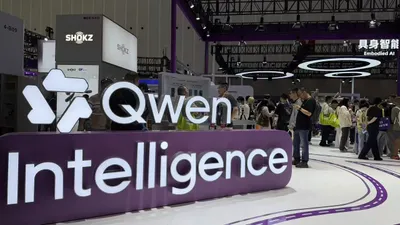
The artificial intelligence road map presented at its flagship Apsara Conference this week showcased a pragmatic pivot by Chinese tech giant Alibaba Group Holding, offering a clearer path to monetisation despite a sharp escalation in capital expenditure, analysts said.
The conference, which ran from Tuesday to Thursday under the theme “Intelligence goes beyond”, highlighted “Alibaba’s disciplined execution across its full-stack AI ecosystem”, said Cathy Chan, an analyst at CCB International.
She pointed out that current investor sentiment had shifted from last year’s enthusiasm for AI catalysts to the need for tangible returns and infrastructure efficiency.
Alibaba’s pitch of treating AI tokens as a utility, using proprietary chips and cloud architecture to reduce inference costs, and releasing open-source model weights to retain developers in its ecosystem, was tailored directly to that more “pragmatic” mood, Chan noted.
Speaking on Tuesday, Alibaba CEO Eddie Wu Yongming laid out three cornerstones of the firm’s push into what he called the “machine intelligence” era: AI models, chips and cloud infrastructure.
Aligning with Wu’s vision, Alibaba introduced the Zhenwu V900, billed as “China’s most powerful AI processor”, alongside its coming Yitian 720 and 730 server central processing units due in 2027, as well as a matching Panjiu supernode server able to scale up to a 500,000-chip single cluster.
The company also teased larger future AI systems with 5 trillion to 10 trillion parameters, alongside upgrades to its multimodal models, capable of processing and generating more than just text. To power internal and external AI models, Alibaba Cloud said it aimed to operate more than 20 gigawatts (GW) of global data centre capacity by 2032.
“Alibaba continues to expand across both enterprise and consumer markets … potentially opening up further opportunities to monetise AI applications,” Citic Securities analyst Liao Yuan wrote in a note.
At the application layer, Alibaba showcased Qwen Intelligence, an agentic solution for smartphone makers building agents that can act across apps, Model-as-a-Service platforms Bailian and Qwencloud, productivity tool QwenWork, and Accio Work for cross-border commerce.
It also debuted a slew of new hardware, including the “agentic computer” QwenBook, AI glasses, earbuds and a note-taking device.
Following the 20GW target announcement, Alicia Yap, head of Pan-Asia internet research at Citi, raised estimates for Alibaba’s capital expenditure in fiscal 2027, 2028 and 2029 to 258 billion yuan (US$38.5 billion), 283 billion yuan and 282 billion yuan, respectively, representing increases of 13 per cent, 41 per cent and 57 per cent above previous figures.
Citic Securities estimates suggest the 20GW target could support roughly US$170 billion in annual external cloud revenue, aligning with Alibaba’s ambition to generate more than US$100 billion in combined external cloud and AI revenue by 2030.
Citic’s Liao said the tighter coupling of Alibaba’s models, chips and cloud “strengthened the visibility of growth”.
The buildout echoes a wider industry push. Morgan Stanley earlier this month forecast 8.5 trillion yuan of AI infrastructure spending in China between 2026 and 2030 – averaging 17 per cent of total spending by US peers – and expected China’s information technology power capacity to rise from 26GW last year to 81GW by 2030.
Alibaba’s semiconductor road map showed the company’s bottleneck had moved beyond chip design, according to Parv Sharma, a senior analyst at Counterpoint Research.
“Leading-edge nodes, HBM [high-bandwidth memory] supply, and advanced packaging” were now the main constraints, Sharma said. He added that Alibaba was seeking to offset Nvidia’s single-chip advantage through cluster scale, interconnects and tighter integration with its Qwen model and software stack.
“The key takeaway is not China overtaking the US, but two separate AI stacks,” Sharma said, adding that Nvidia was benefiting from global supply chains while Alibaba was increasingly dominant at home.