Xi-Trump atmospherics welcomed but mask structural rifts: analysts
During their three-day summit that ended on Friday, US President Donald Trump and Chinese President Xi Jinping worked overtime to underscore their increasingly close relationship even as the meeting produced few concrete deliverables. But the fact that the two economic and military giants are talking – and pledging to talk some more – suggests some period of relative stability ahead, certainly relative to last year’s all-out trade war, chest-thumping and market turmoil, said analysts, companies...
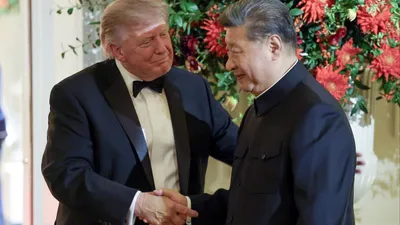
During their three-day summit that ended on Friday, US President Donald Trump and Chinese President Xi Jinping worked overtime to underscore their increasingly close relationship even as the meeting produced few concrete deliverables.
But the fact that the two economic and military giants are talking – and pledging to talk some more – suggests some period of relative stability ahead, certainly relative to last year’s all-out trade war, chest-thumping and market turmoil, said analysts, companies and former US officials.
“Both countries are demonstrating some degree of restraint,” said Sara Schuman, managing director at consultancy Beacon Global Strategies and a former US diplomat in Beijing. “The optics that President Xi is travelling to Washington and he’s receiving a full state visit with a state dinner, this is in itself the core deliverable.”
By that definition, the visit was chock full.
Xi said the two leaders were “making history” with two summits in four months and two more meet-ups planned, one in November for the Asia-Pacific Economic Cooperation summit in Shenzhen and another the following month at the G20 Trump is hosting in Miami.
And Xi spent the Mid-Autumn Festival outside China, only the second time during his near 14-year administration he has done so.
Trump, for his part, greeted Xi in person when he arrived at the airport, a role usually reserved for lower-level officials and a courtesy that the Chinese president did not extend to Trump when he landed in Beijing in May.
Both leaders also spent the 42-hour visit implicitly or explicitly framing China as an equal or near-equal global power, outlining the “great promise” of the bilateral relationship built on “mutual trust”, foreshadowing “a truly great friendship” like a “river that never stops flowing” as they “steer the giant ship of China-US relations steadily forward towards the future”.
No mention of rare earth minerals stand-off
Unspoken was the hugely consequential cudgel China has unsheathed: its global grip on rare earth minerals, which has fundamentally shifted the power balance after Trump pushed Beijing to the wall, threatening tariffs in excess of 125 per cent during last year’s “Liberation Day”.
Add China’s accelerated bid to diversify its trade dependence on US markets, its increasingly competitive artificial intelligence industry and its dominant position in electric vehicles, lithium batteries and renewable technologies, and it is not difficult to understand Beijing’s growing confidence.
Since then, Beijing has negotiated a trade truce with the US, which was extended this week until January 10; seen the transactional US president reframe Taiwan and high-end semiconductors as negotiable; forestalled a planned US$14 billion arms package to Taipei; pushed away US threats to sanction Chinese banks and refineries for bypassing Washington’s Iran sanctions and watched as greater distance opened between Washington and such long-time allies as Japan and South Korea.
“This is Xi Jinping’s world, and we’re all living in it,” said Scott Kennedy, senior adviser at the Centre for Strategic and International Studies (CSIS). “The administration’s China strategy was poorly designed from the beginning. They thought they could use massive unilateral pressure to force China to make concessions, and that did not occur. In fact, the opposite did.”
Time and relative stability afford China more time to develop its increasingly successful trade strategy, allow Beijing to focus on its domestic economy rather than respond to erratic tariff gyrations, and see Washington increasingly distracted by Trump’s war of choice in Iran, the trade war with Canada, and his record-low popularity leading into the November midterm election.
Missing Chinese holidays, travelling repeatedly to the US by a president whose trips are carefully calibrated, displaying keen interest in Trump’s new helipad and supporting his bid to rebrand AI as “Super Intelligence”, expressing warmth hardly instinctual in China’s more austere political culture and making favourable references to Trump’s “make America great again” mantra may be a small price to pay.
“China has flexed its muscle, established its ability to counterstrike and the credibility of its retaliation,” said Yun Sun, China director at the Simson Centre. “Xi Jinping will visit Washington any day to be the peer of his US counterpart.”
In addition to the two-month trade truce extension, the week’s modest, more conventional deliverables included a likely Board of Trade deal involving reciprocal trade carve-outs subject to reduced tariffs that is likely to include some combination of “non-strategic” farm products, apparel, consumer electronics and other manufactured goods. Details are due out on Monday.
But analysts also said the increasingly frequent meetings between Xi and Trump, who favours in-person negotiations unencumbered by extensive planning or expert input, make it difficult to expect the sort of big-dollar deals and structural reforms that often took years of intensive negotiation under past US administrations.
Warm “friendship” at the very top also masks underlying seams, analysts said. Hawks on both sides quietly resist ostensibly closer ties. Important lower-level channels across the Pacific have winnowed as both presidents pared down officials in the military and broader bureaucracy. And growing competition and rivalry leave deep reservoirs of distrust. The lack of written agreements also lays the groundwork for misunderstanding.
“There’s been so much miscommunication or differing perceptions from both sides coming out of these summits,” said Emily Kilcrease, senior fellow at the Centre for a New American Security and a former senior US Trade Representative negotiator.
“Given how low the trust is between these two countries, it’s really important that people know who their counterparts are and can call them when there’s a crisis.”
US visit helps Xi-Trump bromance to blossom
Framing the budding Trump-Xi bromance are more than a few similarities, analysts said. Both believe they are battling “deep state” bureaucratic resistance. Both enjoy the pomp and pageantry of their power.
Both believe their economic model is superior, that their AI and technology will win out. And both face domestic economic challenges.
“When you see Xi Jinping and Donald Trump together, each of them believes that time is on their side,” said Edgard Kagen, a CSIS senior adviser and former political chief with the US Embassy in Beijing. “The US [believes it] will develop alternative sources of critical minerals and rare earths, and so time is on the US side. When Xi Jinping sits down with Donald Trump, he very much believes the US is in a hurtling decline and the time is on China’s side.”
“Neither of them has an interest, at least at this point, in an escalation on trade issues.”
Two more presidential meetings this year are likely to help maintain bilateral stability. They are also likely to push off any Taiwan arms package.
But the prospect of Trump alongside Russian President Vladimir Putin at both – Moscow’s representative attended the two-day G20 Finance Ministers meeting in North Carolina starting August 31, and Putin is expected in Shenzhen – could further weaken traditional US alliances, some said.
“Trump continues to berate many of our closest allies, from Canada to Europe to Korea to Japan. At the same time, when he meets with US adversaries, usually he says relatively nice things,” said Zack Cooper, senior fellow at the American Enterprise Institute and a former National Security Council official.
“That message would be heard loud and clear, and it will just further accelerate the drive from a lot of US allies to decrease their reliance on the United States. And it may embolden Russia and China to test those alliances even more.”
With so much at stake, experts say, the test will be whether this week’s atmospherics lead to longer-term equilibrium or a return to instability.
“You can have a state visit, respectful rhetoric, a very good dinner, while both governments continue to build tools to compete with each other the next day,” said Craig Singleton, a senior fellow at the Federation for the Defence of Democracies and a former US diplomat.
“I don’t expect a reset in US-China relations. I do not expect a grand bargain on trade. I don’t expect Washington and Beijing to resolve their technology competition, economic security disputes, or any fundamental disagreement over Taiwan.”
“It’s a summit about managing stalemate, not resolving it.”