Big picture or big deals? What the Xi-Trump summit holds for China and the US
With the balance of power shifting between the US and China, the success of this week’s summit hinges not on headline-grabbing deals, but on practical, cautious consensus under a new strategic stability framework, according to Chinese researchers. Media outlets in China have given heavy coverage to President Xi Jinping’s state visit to the United States, highlighting its “historic, milestone significance”. It follows US President Donald Trump’s Beijing visit in May. Xi’s arrival in Washington on...
With the balance of power shifting between the US and China, the success of this week’s summit hinges not on headline-grabbing deals, but on practical, cautious consensus under a new strategic stability framework, according to Chinese researchers.
Media outlets in China have given heavy coverage to President Xi Jinping’s state visit to the United States, highlighting its “historic, milestone significance”. It follows US President Donald Trump’s Beijing visit in May.
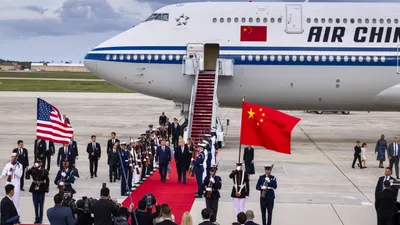
Xi’s arrival in Washington on Wednesday dominated state media headlines, with images and footage of Trump greeting the Chinese leader on the tarmac in a red-carpet welcome that included honour guards, a military band that played both national anthems, a 21-gun salute and a jet flyover.
In contrast, American media coverage of Xi’s arrival was more muted, as the major television networks continue a stand-off with the White House. Those in the White House pool – including ABC, CBS, CNN, Fox News and NBC – have boycotted coverage of Trump’s public events in protest against his administration’s ban on several media outlets including CNN.
Camera crews had set up at Joint Base Andrews in anticipation of a court ruling to lift the ban but dismantled their equipment after a federal judge deferred his decision. As a result, the arrival of China’s top leader was captured by a handful of smaller digital outlets, The New York Times reported on Wednesday.
The media chaos underscores the deep partisan strife and divisions in the United States – turbulence that will make it harder for the visiting Chinese officials to set the tone for stable ties during the Xi’s visit.
Trump has met several foreign heads of state since taking office in January last year, but the high-level airport reception for Xi is particularly unusual. Trump has never greeted a visiting leader at Joint Base Andrews, typically waiting to greet them at the White House instead.
When Japanese Prime Minister Sanae Takaichi made her first visit to Washington in March, she was greeted at Joint Base Andrews by US Air Force Colonel Gary Charland, before going to the White House for talks with Trump.
This week, Takaichi met with Trump again during the UN General Assembly in New York, a day before Xi’s arrival in Washington.
Chinese media gave wide coverage of her landing at New York’s John F. Kennedy International Airport, highlighting that she was met by Japanese officials – with no red carpet, protocol delegation or US officials in attendance.
Sun Chenghao, a fellow with the Centre for International Security and Strategy at Tsinghua University, said Xi’s airport welcome “sends a clear political signal”.
“It shows Trump’s high regard for the Chinese leader and US-China relations, as well as his intent to advance further improvements in relations through head-of-state diplomacy,” Sun said.
Several major US think tanks noted in reports this week that the summit would be more of an exercise in diplomatic optics and unlikely to produce substantial progress beyond a temporary extension of the Busan truce. US Treasury Secretary Scott Bessent said on Wednesday local time that the agreement would be extended past its November deadline to January 10.
But it is widely acknowledged that the summit is too important to fail – for both sides.
Trump’s sinking approval ratings at home are threatening to drag down Republicans in November’s midterm elections, with voters blaming his administration for high prices and a shaky economy.
Beijing is also facing domestic pressures. Beyond a sluggish economic recovery, the ruling Communist Party is preparing for its fifth plenum in October – a key gathering to discuss a new line-up of party leaders.
“Trump faces midterms in under six weeks. Xi returns home to begin a year-long run-up to next fall’s party congress, where he is expected to secure another five-year term,” Rush Doshi, a senior fellow at the Council on Foreign Relations, wrote in a report on Tuesday.
Chinese researchers argued that given the turbulence of relations in recent years, securing any tangible agreements or reinforcing existing frameworks would be an achievement in itself.
The two nations have a dense, concrete agenda spanning agricultural purchases, aircraft procurement, semiconductor technology, critical minerals and the potential extension of a tariff truce.
“Considering the overarching backdrop of competition and even conflict that has defined US-China ties for quite some time, reaching actionable agreements on these specific topics is valuable,” said Wang Yong, director of the Centre for International Political Economy at Peking University.
“It is simply unrealistic to expect a single, sudden ‘megadeal’ that resolves all problems at once.”
According to Wang, the most profound shift lies in Beijing’s increasingly proactive role in shaping the direction of bilateral ties. This stemmed from a substantive, realigning shift in the power balance, which had forced Washington to recognise Beijing as a peer competitor, he said.
Echoing this perspective, Shen Yi, executive director of the Centre for National Security Studies at Fudan University in Shanghai, cautioned that anyone who overlooked this shifting equilibrium risked underestimating the value of strategic consensus and ignoring the progress made through established mechanisms.
Shen also noted that the vicious cycle of retaliatory tariffs had stopped, or at least had been suspended, indicating that the bilateral economic and trade consultation mechanism was functioning.
Furthermore, Washington was gradually coming around to Beijing’s view that bilateral trade and investment offered mutual benefits and that economic ties should not be entirely driven by security.
Shen said it would be impossible to iron out all the differences in one or two meetings and that summit diplomacy served mainly to set the overall tone.
“Even if the leaders agree only on broad principles, it provides a crucial guiding framework for pushing relations forward, particularly on the Chinese side,” Shen said.
“We can maintain cautious optimism that the ‘constructive strategic stability’ framework will be enriched with more substance through incremental, prudent progress.”
Wang said Beijing’s priority was to stabilise ties by reinforcing the new strategic framework agreed on at the Beijing summit with practical deals and communication mechanisms, while maintaining normal trade in non-sensitive business sectors.
However, execution remains a major hurdle. Shen said the basic challenge was a trust deficit, given the Trump administration’s record of reneging on commitments.
The stakes are equally high regarding Taiwan, which Trump has previously referred to as a “very good negotiating chip”.
The South China Morning Post reported earlier that Washington was considering delaying arms sales to Taipei ahead of Xi’s visit.
Beijing sees Taiwan as part of China to be reunited by force if necessary. Most countries, including the United States, do not recognise Taiwan as an independent state, but Washington is opposed to any attempt to take the self-ruled island by force and is committed to supplying it with weapons.
Shen said the “Taiwan card” was historically a by-product of an asymmetric power dynamic. That leverage, however, was fading as China’s strength grew and Beijing reserved the right to counter.
“Were the US to take a positive stance on Taiwan, would China not reciprocate?” Shen said.
Ultimately, across all flashpoints – including Taiwan – the core dilemma is not whether promises can be made, but whether Washington has the will and capacity to enforce them, according to Shen.
“A defining feature of US-China relations is that Beijing’s stance and actions on core national interests remain steady and predictable,” Shen said. “The uncertainty stems from the American side.”
Additional reporting by Caroline Lin and Orange Wang