Von der Leyen promotes EU resilience despite great perils
Ursula von der Leyen made a bold pitch for European resilience and independence in her longer-than-usual State of the Union speech in Strasbourg.
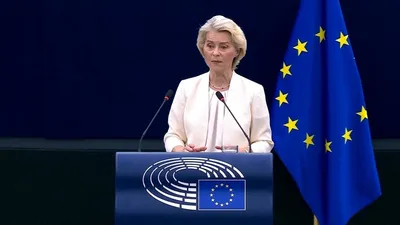
Ursula von der Leyen made a bold pitch for European resilience and independence in her longer-than-usual State of the Union speech in Strasbourg.
The challenges that confronted the European Commission president a year ago have only become more perilous - climate change, AI, an intensifying Russian hybrid war on European soil, a deepening trade deficit with China, ongoing hostility from the Trump administration, and the inexorable rise of far-right parties, even in the two anchor member states France and Germany.
The speech was revised repeatedly before delivery, especially when it comes to AI - the debate on rogue artificial intelligence destroying humanity has only properly broken through to the political sphere in the United States.
President von der Leyen's communications strategy has always been to focus on the positive, even in light of the pressure the EU is under from east and west.
"The state of our union is the strongest it has ever been," she told MEPs.
"The state of our union can also feel as precarious as it has ever been.
"These two statements may seem incompatible. But they are both true. And they reflect these exceptional times.
"This complex age of great possibilities and great perils which all countries are seeking to navigate."
The key navigation tool for Ms von der Leyen is partnership and the standout moment was her welcome to Canadian Prime Minister Mark Carney and the offer of EU associate membership to Ottawa.
"For some, the answer is to go it alone," she said.
"But this is not an option for us. Europe will always lead when it comes to defending the rules-based system.
"But we can no longer rely on it as the only way to secure our interests. Or assume that its rules will shelter us from the complex threats that we face."
There were offers of greater collaboration on security and defence with Norway and the UK (the Norwegian foreign minister has formally welcomed the offer), but the associate membership idea will grab the headlines as much for its clear reflection of the EU-US estrangement, but also what precisely it means.
There is nothing in the EU treaties that references "associate membership".
While various leaders have, over recent decades, spoken of inner and outer circles of membership, with a core group of countries driving integration, such plans have never come to fruition, and no-one has ever spoken about "associate membership".
The EU and Canada have a free trade agreement - CETA - which only 17 member states have ratified (Ireland still has not ratified it).
What would associate membership mean in terms of free movement of people, a further lifting of trade barriers?
Describing the offer as "possibly historic", Fianna Fáil MEP Barry Andrews said the benefits for Ireland could be "vast".
"We also need to consider full and free work and travel visa arrangements between Europe and Canada as part of upcoming negotiations," he said.
"Thousands of Irish already travel to work in Canada on temporary visas, so this EU associate membership will help their legal status in future.
"Also, Ireland can attract more Canadians to come, live and work in Ireland."
The offer will no doubt disorientate those candidate countries - Ukraine, Moldova, Albania, Montenegro, North Macedonia - who are wary of anything that stops short of full membership.
The idea is also likely to set tongues wagging in the UK about whether the offer to Canada might be extended to Britain.
Ms von der Leyen focused on the tipping points of climate change, AI and China.
For the left, the focus now on Europe "adapting" to global warming - building a new European Firefighting fleet and a new Emergency Response to heatwaves, for example - will be seen as a surrender to those who reject Europe’s "mitigation" efforts – i.e. the Green Deal.
President von der Leyen said both mitigation and adaptation must go hand in hand, but that has not satisfied everyone.
"Despite a chaotic summer, she continues to hammer home that competitiveness is the priority, using it to justify deregulation that is wiping out any progress on environmental protection," said Left co-president Martine Aubrey MEP.
Other initiatives designed to appeal to the left and centre-left also appeared to fall flat.
The announcement of a European Care Deal was pitched with the promise that care for the elderly, in the same spirit of the EU’s attempt to lower the cost of housing, was "a right, not a privilege".
However, the response to the Affordable Housing Act announced last week has been lukewarm at best.
There was a welcome for the promise of tougher action against China, now enjoying a trade surplus of €1bn per day - another Von der Leyen "tipping point".
She told MEPs: "Let me be clear: we will use all the tools at our disposal to rebalance our relationship. Words are good. But deeds are better."
Despite not spelling out what those deeds will be, it was welcomed by Bernd Lange MEP, the influential chair of the European Parliament trade committee.
"Von der Leyen was clear on China," he posted on X.
"Europe must reduce economic dependencies and defend its interests. That also means stronger European coordination on critical raw materials, including joint procurement and strategic reserves."
Campaigners against the harmful effects of social media on children will be heartened by the promise of the EU KIDS Act, a proposal to be adopted tomorrow which foresees no social media under the age of 13, no personal accounts under the age of 15 and only mini accounts set up and supervised by parents for those aged between 13 and 15, with mandatory safe design for all under 18 accounts.
Fine Gael MEP Sean Kelly said the measures should have gone further.
"These EU-wide measures must introduce new protections for children and more tools to enable parents or guardians to help keep their kids safe.
"Most importantly, they need to be clear that social media use is not appropriate for those under the age of 16 and legislate accordingly."
There was a mixed response to a raft of measures on security and defence.
These include a proposed NATO Article 4-style solidarity measure, in light of Russia’s escalating hybrid attacks, whereby an attack on one member state would prompt a collective EU response.
A European Security Council, working with Canada, Norway, the UK and Ukraine, as well as a European Instrument for Strategic Enablers, which would be "fully aligned with NATO" in order to deliver capabilities in air and missile defence, strategic transport and air-to-air refuelling, space and cyber, will be carefully examined by NATO member states to ensure there is no overlap.
The Irish Government has been lukewarm to say the least about plans to give the EU’s existing mutual support clause, Article 42.7 of the Lisbon Treaty, more of a Ukraine-linked relevance.
Dublin is likely to be equally queasy about a NATO Article-4 style commitment.
IBEC’s head of EU and International Policy Neil Willoughby said in a statement that the EU’s security and resilience remained a key issue for Irish businesses, including "protecting critical infrastructure, mitigating the damage created by cyber threats, and avoiding disruption to supply chains are critical components of business".
Critics will say many of the eye-catching pledges amount to little more than repackaging existing, or in-the-pipeline, initiatives, especially on defence and climate change.
Supporters will say President von der Leyen has provided a jolt of self-confidence to Europe’s ability to forge its own way, standing up to Big Tech on social media and AI, boosting the EU’s ability to defend itself in the face of predatory threats by Russia and Donald Trump’s America, and confronting China.
All the ambitions will undoubtedly require an expanded EU seven-year budget.
As the Irish EU Presidency will tell, getting that over the line will be one tall order.