Editor's Choice: Another Trump-Xi ambiguous summit
Hello from Tokyo. U.S. President Donald Trump and Chinese President Xi Jinping met in Washington on Thursday, marking their second face-to-face meetin
Akito Tanaka shares his weekly reflections and recommendations
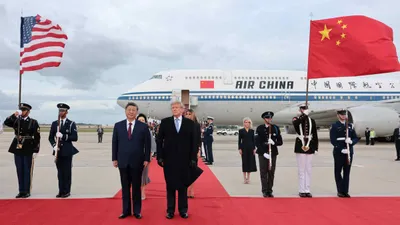
U.S. President Donald Trump greets Chinese President Xi Jinping at Joint Base Andrews, Maryland, on Sept. 23. © Reuters
Hello from Tokyo. U.S. President Donald Trump and Chinese President Xi Jinping met in Washington on Thursday, marking their second face-to-face meeting this year after their May summit in Beijing . The White House rolled out the red carpet for Xi, with Trump personally greeting the Chinese leader at Joint Base Andrews, an unusual gesture that underscored the importance Washington attached to the state visit.
Nikkei Asia has been closely covering this event in blog format . At first glance, the summit looked like a major geopolitical event. In reality, however, the most consequential development had already taken place before the two leaders sat down together.
Following talks with Chinese Vice Premier He Lifeng, U.S. Treasury Secretary Scott Bessent announced an agreement to extend the U.S.-China trade truce by another two months. Given the potential global economic consequences, this announcement may be more significant than anything that emerged from the summit itself.
Like the Beijing meeting earlier this year, this week's summit appeared to be largely ceremonial. According to a Xinhua readout, Xi once again sought reassurance on the U.S. position toward Taiwan. On artificial intelligence, he called for the world's two largest economies to ensure that AI remains under human control. Additional agreements may still emerge, but for now the summit's tangible achievements remain unclear.
That ambiguity, however, may have been exactly what Trump wanted.
With November's midterm elections approaching, the U.S. president is eager to demonstrate progress on the global stage. By holding a smooth summit with America's foremost strategic rival and meeting Xi twice in just over four months, Trump can argue that he has built a strong working relationship with China's leader, regardless of whether the meetings produced breakthrough agreements.
The international community, along with media organizations including Nikkei Asia, watched the summit closely in anticipation of major news. Yet the biggest takeaway may be what did not happen: no new confrontation, no dramatic breakthrough, and no clear shift in the trajectory of U.S.-China relations. Nikkei Asia will continue to follow developments closely and provide in-depth coverage of U.S.-China relations and what they mean for Asia and the world, so please stay tuned.
1. Ahead of this week's Trump-Xi summit, a familiar Western demand resurfaced: Let the yuan rise. As China's trade surplus builds toward another record and estimates suggest its currency remains as much as 30% undervalued, economists and policymakers are increasingly arguing that a stronger yuan is needed to rebalance trade flows . Europe, where manufacturers are under intense pressure from Chinese rivals, has been particularly vocal about this point.
But while Beijing has allowed some carefully managed yuan appreciation, Chinese policymakers fear a rapid rise would squeeze already thin exporter margins, worsen unemployment and deepen the deficiency in domestic demand.
2. Indonesian digital lender Superbank is enjoying robust growth in customer numbers, loans and net profits. In an interview with Nikkei Asia , CEO Tigor Siahaan talks about Superbank's strategy, including the use of high deposit rates and "piggybacking" on Singaporean ride-hailing giant Grab. He also touches on the consolidation of Indonesia's banking industry and calls weaker purchasing power and external volatility "short-term noises."
3. A massive marketing misstep by Starbucks has been percolating through South Korea's ultra-competitive coffee shop market. Local rivals such as Twosome Place have been growing their market share on the back of customers shunning the U.S. company's outlets over its insensitive "Tank Day" promotion that coincided with the anniversary of a brutal military crackdown. This week's Business Asia examines whether Starbucks can recover in one of its largest Asian markets.
Thank you for reading this newsletter. We are taking a short break and will be back in your inboxes on Oct. 9.