Russia-Ukraine war disrupts wheat supply: Which countries are running short and where are they turning for supplies?
Russia-Ukraine war is disrupting wheat shipments from the Black Sea, forcing major buyers such as Egypt, Indonesia and Vietnam to seek supplies from Australia, Argentina, France and other exporters, as tighter supplies push up prices and raise food inflation risks.
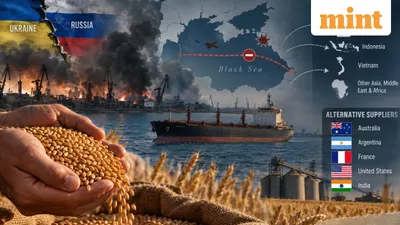
Global wheat buyers that delayed purchases in the hope that shipments from the Black Sea would resume are now facing a difficult choice: either replenish dwindling stocks at higher prices or wait for supplies from Russia and Ukraine to recover.The Black Sea region has been a crucial source of wheat for importers across Asia, the Middle East and Africa. But attacks on vessels, ports and grain infrastructure since July have disrupted shipments from Russia and Ukraine, pushing major buyers to look for supplies elsewhere.Russia and Ukraine account for more than a quarter of global wheat trade, according to Bloomberg, while Kpler estimates that their seaborne exports account for around 30% of global wheat exports.
The disruption has already pushed benchmark Chicago wheat futures about 40% above their June lows to a three-and-a-half-year high, while wheat from alternative suppliers has also become more expensive.What is happening in the Black Sea? The Russia-Ukraine war has disrupted the movement of wheat from the Black Sea, with attacks hitting ports, grain terminals, silos and vessels. Russian wheat exports are on track to fall to around 1 million tonnes in September from 5 million tonnes a year earlier, while Ukraine is expected to ship about 1 million tonnes this month, half the level of September last year, according to Kpler estimates.
The disruption is particularly important because Russia and Ukraine together account for more than a quarter of global wheat trade. Their crops are important sources of supply for some of the world's biggest wheat-importing nations, including Egypt, Indonesia, Bangladesh and Vietnam. Ukraine is facing an additional problem. Its ports around Odesa, which normally handle about 90% of the country's grain exports, have been repeatedly attacked.
The country is therefore trying to move more grain through Romania's Constanta port, Danube ports, road networks and railways. But these routes cannot fully replace deep-sea Black Sea shipments. A backlog of around 80 vessels, mostly smaller ships, has built up around Ukraine's Danube ports, according to ship-tracking data compiled by Kpler and Bloomberg. Low water levels on the Danube have also complicated efforts to increase shipments through Romania.
Russia, meanwhile, is attempting to move grain through alternative routes including the Baltic and Caspian seas, Kazakhstan and the Far East. But these routes are more expensive and have limited capacity. Moving grain through the Far East, for instance, requires thousands of additional miles of rail transport. Which countries are most affected? EgyptEgypt, the world's biggest wheat buyer, is among the countries most exposed to the disruption.In the first half of September, Egypt's wheat imports fell to 143,870 tonnes from 876,139 tonnes a year earlier, according to official data.
Russia and Ukraine accounted for a large share of its shipments.Egypt is now looking towards France and other European suppliers. The country's supply minister, Sherif Farouk, said Egypt was diversifying away from Russia and Ukraine.Southeast AsiaIndonesia, the world's No. 2 wheat importer, received only around 60,000 tonnes of wheat from the Black Sea this month, compared with about 500,000 tonnes in September last year, according to Kpler.Indonesian millers are therefore looking towards Argentina and Australia.
But Australian wheat is costing around 20% to 25% more than the Black Sea cargoes they had previously booked.Some Southeast Asian millers have responded by booking smaller shipments rather than committing to large bulk cargoes because of the higher prices.Vietnam has faced a similar problem.Bangladesh is also looking towards Romania and Argentina, while securing small quantities of wheat from India.Where are buyers turning for wheat?
Australia has emerged as an important alternative for Asian buyers. Argentina is also attracting demand from Indonesia and Bangladesh.European suppliers are benefiting from increased demand as well. Egypt is turning to France and other European suppliers, while Libya has used France's Rouen port for wheat shipments.Other buyers are looking towards Romania and Bulgaria. Vietnam's Golden Wheat, for instance, was able to switch two cargoes to Bulgarian wheat.Some countries are also turning to India after New Delhi recently scrapped its years-long ban on wheat exports.The US is another alternative.
Vietnam turned to US wheat to replace missing Black Sea cargoes, although the supplies came at a higher price.But the sudden increase in demand is putting pressure on these alternative suppliers.Is replacing Russian and Ukrainian wheat easy? The biggest problem is that the disruption is happening at a time when buyers have already allowed their stocks to run down.Many importers held off making alternative purchases in recent months because they were hoping for an agreement between Russia and Ukraine that would allow Black Sea grain shipments to resume.That has left them scrambling for supplies as inventories decline.Indonesian buyers have been paying around 20% to 25% more for Australian wheat than the prices at which they previously booked Black Sea cargoes.Transportation adds another layer of cost.
Russia's alternative routes involve longer rail journeys and additional handling, while Ukraine's road, rail and Danube routes cannot match the capacity of its deep-sea ports.Competition for cargoes is expected to intensify as importers with dwindling stocks return to the market. Southern Hemisphere harvests will provide additional supplies later in the year, but buyers face a tighter market in the meantime.