Houthi drone near Mecca: Saudi Arabia draws ‘red line’ — has Makkah Pact been tested?
Saudi Arabia intercepted a Houthi drone near Mecca, escalating concerns over the Yemen war's proximity to Islam's holiest site. The incident follows a defence pact involving Saudi Arabia, Pakistan, and Turkey amidst rising threats from the Houthis supported by Iran.
Saudi Arabia’s interception of a Houthi drone south of Mecca has brought the Yemen war dangerously close to Islam’s holiest city. Saudi air defences intercepted and destroyed what Riyadh said was a Houthi-launched drone south of Mecca on Tuesday, September 15, before it entered the prohibited airspace over the holy city. Coalition to Restore Legitimacy in Yemen spokesperson Major General Turki al-Malki said the security of the Two Holy Mosques and pilgrims was a “red line” and warned that the coalition would take necessary deterrent measures against the Houthis.
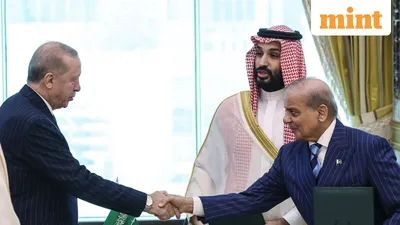
The Houthis, in a post on X, denied that they had targeted Mecca, calling the Saudi claim false. The incident comes barely a month after Saudi Arabia, Pakistan and Turkey signed the Makkah Joint Defence Agreement, under which an armed attack against any one of the three countries is to be regarded as an attack against all three. The agreement was also signed in Mecca on August 7. And that is where the latest Houthi escalation creates an uncomfortable test for Islamabad.
The language of the Makkah Joint Defence Agreement is broad. An armed attack against one signatory is to be regarded as an attack against all, similar to NATO's Article 5. But the agreement does not publicly spell out an automatic military response, nor does it specify what form assistance must take in every circumstance. Reuters noted at the time that the responsibilities under the pact remained vague. The Houthis have expanded attacks on Saudi territory, including cities and energy infrastructure, while the conflict in Yemen has simultaneously moved closer to the strategic Bab al-Mandab Strait.
So far, Islamabad has been careful not to cross that line. Islamabad’s flip-flop Earlier, Pakistan Defence Minister Khawaja Asif recently suggested that the pact could become operational if Saudi Arabia faced “unprovoked aggression” or the Yemen conflict spilt into the kingdom, as he was quoted by Geo News. But later, Islamabad backtracked and sought to narrow expectations. On September 10, Pakistan Foreign Ministry spokesperson Sajjad Haider Khan said there was no military response under discussion in connection with the Houthi attacks.
At the same time, he maintained that Pakistan would act “when the time comes” under the agreement. Afterwards, Prime Minister Shehbaz Sharif came in a damage-control mood and called Crown Prince Mohammed bin Salman and condemned the Houthis' attacks on Saudi civilian and economic infrastructure. Sharif stressed Pakistan's solidarity with Saudi Arabia and said Islamabad would continue efforts to “defuse” regional tensions.Pakistan has substantial military ties with Saudi Arabia.
The new agreement builds on longstanding defence cooperation between the two countries. Under a separate bilateral framework, the Strategic Mutual Defence Agreement signed in September 2025, Saudi authorities confirmed in April that Pakistani troops, along with fighter and support aircraft from the Pakistan Air Force, had arrived at King Abdulaziz Air Base amid heightened regional tensions. The Houthis are not just a conventional state adversary.
They are a powerful armed movement operating from Yemen and backed extensively by Iran. American think-tank Council on Foreign Relations says Iranian assistance has included weapons, training and intelligence support, helping the Houthis develop capabilities that allow them to project force into the Red Sea and Bab al-Mandab. That makes any Pakistani military intervention potentially more complicated than simply defending Saudi territory.
The Houthis have moved beyond sporadic attacks and are now threatening the security architecture surrounding the Red Sea and Bab al-Mandab. Recent Houthi advances along Yemen's Red Sea coast have heightened concerns over the strategic maritime chokepoint, while attacks on Saudi infrastructure have added a direct economic dimension. CFR describes Bab al-Mandab as a crucial chokepoint for global energy flows and notes that Iranian support has helped the Houthis build the ability to project power into the strait and the wider Red Sea.
Iran has already used the geostrategic leverage of its geography during the Iran war, choking the Strait of Hormuz and creating an energy crisis. Ditched by Pak, Saudi looks to Israel for help After being ditched by the Pakistan-led alliance, the clearest sign that Riyadh is not relying exclusively on the new trilateral arrangement is the emergence of reports about Saudi efforts to obtain outside intelligence and security assistance.
The Jerusalem Post report citing diplomatic sources say Saudi Arabia and Israel have held discussions, mediated by US Central Command, about intelligence assistance against the Houthis. The reported cooperation is focused on intelligence. Neither Saudi Arabia nor Israel has publicly confirmed the arrangement. There have also been reports that Riyadh sought British assistance in dealing with the Houthi threat to Bab al-Mandab and Saudi energy infrastructure.
Saudi Arabia appears to be building a wider security network rather than waiting for help from the Makkah Joint Defence Agreement alone to determine its response. Given the developments after the attack, Pakistan’s balancing act is now under the spotlight With inputs from Reuters, AFP