Missing Celtic fort annihilated by Julius Caesar finally found under Paris hospital
Archaeologists in Paris have discovered the remains of a missing Celtic fort sacked by Julius Caesar in 52 B.C.
 Brain Rot Premium$ROT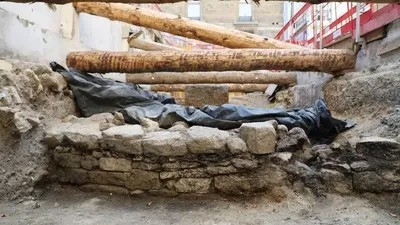
Archaeologists excavating a Paris hospital's courtyard, a stone's throw from Notre-Dame, have discovered the first evidence of a Celtic fort that Julius Caesar tried to conquer in 52 B.C. The ancient walls show evidence of a violent fire, seemingly confirming the claim that the Celtic group who lived there, known as the Gauls, burned down their own town so that it wouldn't fall into Caesar's hands.
"The wall's architecture, with its large blocks and interlocking beam system, immediately led us to believe it was a wall of Gallic tradition," Dorothée Chaoui-Derieux , chief curator of heritage at the Île-de-France Regional Archaeology Service, said in a translated statement . Traces of fire and first century B.C. artifacts further suggested the archaeologists had finally found material evidence of Lutetia, a Celtic settlement mentioned in Caesar's Gallic Wars .
In the first century B.C., Lutetia was a Celtic pre-Roman settlement, known as an "oppidum", in what is now Paris. Lutetia was the capital city of the Parisii tribe, who lived along the River Seine. As part of the Gallic Wars, which ran from 58 to 50 B.C., Julius Caesar and his troops fought the Battle of Lutetia in 52 B.C. The Romans won a decisive victory, but the Gauls burned Lutetia and cut the bridges so that Caesar could not take the town. As a result, the ancient fort had never been found.
Archaeologists have been working at the excavation site, on the Île-de-la-Cité in Paris, since February 2026. (Image credit: Anastasia Choquet/DRAC Île-de-France)
But in February, a team of archaeologists began excavating in the courtyard of the Hôtel-Dieu, which is Paris's oldest working hospital. On the small Île-de-la-Cité island in the middle of the Seine, close to Notre-Dame, the archaeologists discovered a 65-foot (20-meters) stone and timber wall typical of Celtic fortifications. Charred facing, burnt seeds and a burned wooden building discovered nearby suggested the site had been destroyed by a fire.
"The initial results of carbon-14 dating of the wooden elements suggest a date range between 200 and 10 B.C. Furthermore, a Gallic spearhead was found at the foot of the wall," Chaoui-Derieux said.
RELATED STORIES
• Did Celtic women fight in battle?
• 2,000-year-old Celtic teenager may have been sacrificed and considered 'disposable'
• 5 'extremely rare' iron shackles discovered in France highlight Celtic slave trade 2,300 years ago
These new discoveries provide solid archaeological evidence that Lutetia was indeed centered on the island in the Seine and that its occupants burned it down, as Caesar noted in his Gallic Wars more than two millennia ago.
"This discovery fills an archaeological gap. For centuries, the location of Lutetia has been debated," Stéphane Deschamps , regional curator of archaeology at Île-de-France Regional Archaeology Service, said in the statement. "Today, with this wall and its context, we may hold the key to the mystery."
But the remains of the wall and other artifacts are extremely fragile because of their exposure to fire, according to the statement. The wall cannot be fully preserved, so archaeologists will create a replica using 3D photogrammetry to ensure the discovery is accessible to everyone.
See how much you know about the Celts with our Celtic quiz!