EU Agrees to Release €6.6B for Ukraine From EPF, Once Blocked by Orbán
EU member states agreed to release €6.6 billion (about $7,5 billion) from the European Peace Facility (EPF), EU foreign policy chief Kaja Kallas said on Friday. The fund, used partly to reimburse military aid to Ukraine, had been blocked since 2023 by Hungary under former Prime Minister Viktor Orbán.
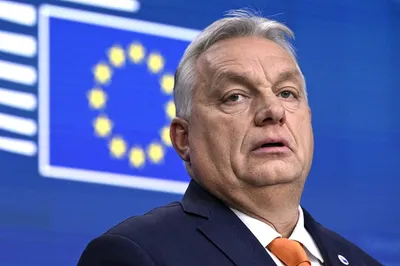
In brief: EU member states agreed to release €6.6 billion (about $7,5 billion) from the European Peace Facility (EPF), EU foreign policy chief Kaja Kallas said on Friday. The fund, used partly to reimburse military aid to Ukraine, had been blocked since 2023 by Hungary under former Prime Minister Viktor Orbán.
EU member states have agreed to release €6.6 billion (about $7.5 billion) from the European Peace Facility ( EPF ), ending years of deadlock over a fund that Hungary kept blocked since 2023.
EU High Representative for Foreign Affairs and Security Policy Kaja Kallas announced the agreement in a statement on Friday, Sept. 25, while Ukraine’s Ministry of Defense welcomed the decision shortly after, expressing gratitude to EU member states for “turning political resolve into military capability.”
Follow our coverage of the war on the @Kyivpost_official .
“That’s good news for Ukraine and bad news for Russia,” Kallas said, adding that “Moscow’s hybrid attacks try to intimidate Europe into scaling back its support for Ukraine.”
“Europe is doing the opposite,” she concluded.
Under the mechanism, aimed at preventing conflicts and strengthening international security, EU member states can be reimbursed for military equipment they have donated to Ukraine.
Of the total, €900 million (roughly $1 billion) will be used to finance the EU Military Assistance Mission for Ukraine (EUMAM Ukraine), through which Ukrainian soldiers are trained across the EU.
Another €1 billion (approximately $1.1 billion) will fund new joint procurement of equipment, while the remaining €4.7 billion (roughly $5.4 billion) will be reimbursed to member states, Kallas said.
Worth over €17 billion (about $19 billion), the EPF is a fund financed outside the EU budget for a period of seven years, starting March 2021.
It is a single mechanism that finances all actions under the Common Foreign and Security Policy (CFSP) in military and defense, according to the European Council, who raised the EPF’s financial ceiling three times.
In March 2023, the ceiling was raised by €2.29 billion (roughly $2.6 billion). In June, it was raised by €4.06 billion (about $4.6 billion).
By March 2024, the Council created a dedicated Ukraine Assistance Fund within the facility, raising the financial ceiling by €5 billion (roughly $5.7 billion)
Led by former Prime Minister Viktor Orbán for 16 years, Hungary opposed military aid to Ukraine and refused to unblock the use of the mechanism.
On Sept. 9, the EU General Court dismissed Hungary’s legal challenge against the use of seized Russian assets to support Ukraine’s military needs.
Although the veto has now been lifted, the diplomatic relations between Kyiv and Hungary remain strained.
On Sept. 18, Ukraine launched a new regional cooperation initiative named Carpathian Eight (C8) cooperation initiative in Bukovel, western Ukraine’s Ivano-Frankivsk region.
The format was initially presented as comprising Austria, the Czech Republic, Hungary, Poland, Romania, Serbia, Slovakia and Ukraine, as well as the EU institutions.
After announcing Budapest will not be joining the format, Hungary’s current Prime Minister Péter Magyar went a step further and linked the format to a village football team, sparking a public dispute and further straining already fragile ties between the two countries.
Foreign Minister Andrii Sybiha criticized what he called Magyar’s “unnecessarily confrontational” position toward Kyiv, saying Hungary’s latest decisions reflected the obstructionism of Orbán’s policies.
Magyar rejected the criticism, while Deputy Prime Minister and Foreign Minister Anita Orbán added that there was “no analogy with the obstructionist policies pursued by Viktor Orbán,” as the Hungarian government has “offered quite a number of gestures” to Ukraine, since taking office.
Meanwhile, Budapest has continued to hold up Ukraine’s EU accession, citing the rights of the ethnic Hungarian minority in Transcarpathia.
By Sept. 8, Hungary had blocked the start of negotiations on clusters 2 and 3 four times . The decision came despite a June agreement between Magyar and President Volodymyr Zelensky on the rights of Hungarian communities in Ukraine.
Orbán’s government had previously stalled the opening of the initial “Fundamentals” cluster for 17 months over the same issue.
Kyiv Post is Ukraine’s first and oldest English news organization, reporting since 1995. Its international reach – 97% of readers are outside of Ukraine – make it truly Ukraine’s global voice.