Video: India, Pak navy warship collision recreated inside simulator
Video: India, Pak navy warship collision recreated inside simulator

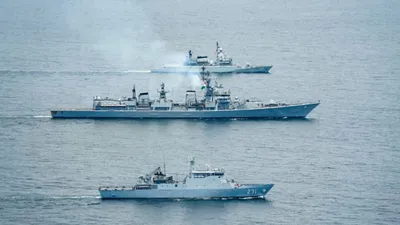
India Today TV has accessed a simulator-based recreation of the September 15 collision between an Indian Navy Kolkata-class destroyer and Pakistan Navy’s PNS Hunain in the northern Arabian Sea.The recreation shows how officers on the bridge of a warship track nearby vessels, assess changes in their movement and make decisions as a potentially dangerous situation develops. It also offers a rare look at the role of simulator training in preparing naval crews for tense encounters at sea.The simulation has been created for illustrative purposes and is not actual footage of the September 15 collision between the two warships.Indian sources had said the destroyer was conducting routine surveillance when PNS Hunain approached at high speed.
Sources also said this was the second such incident in six months in the Arabian Sea involving dangerous close manoeuvres by Pakistan Navy warships near Indian naval assets deployed for surveillance and anti-piracy missions near the Gulf of Aden. WHAT HAPPENS ON A WARSHIP’S BRIDGEThe simulator recreates the environment in which naval personnel practise navigation, surveillance, communication and decision-making.Officers on the bridge must maintain a continuous picture of the vessels around the warship.
They track changes in course, speed and distance to determine whether an approaching ship poses a risk.The commanding officer must then decide how to respond, often within seconds. The options may include altering course or speed, issuing warnings and initiating other procedures to prevent a collision.High-fidelity simulators allow naval crews to encounter such situations repeatedly without placing ships or personnel at risk.
Crews can also practise their responses to sudden course changes, communication failures and other complex situations at sea.‘ TRAINING PREPARES YOU FOR REAL SITUATIONS’Captain Sanjay Kumar (Retd.), director at Zen Technologies, said simulation exercises repeatedly expose naval personnel to challenging situations, preparing them to take decisions under pressure.“ The idea of simulation is to put the officer in situations which are as close to reality as possible.
He has to assess the situation, take the right decision and execute it under pressure,” Kumar said.He said simulator training was not intended to prepare personnel for only one kind of incident. Its broader purpose was to improve situational awareness and enable crews to respond correctly when conditions changed rapidly.“ You train repeatedly so that when a real situation develops, the response comes from training. There is no time to panic or get confused on the bridge,” he added.‘
NEVER LOSE PATIENCE’Commander Ankit Rawal (Retd.), a former submariner associated with Zen Technologies, said naval personnel were also trained to remain calm when faced with provocative or unpredictable actions.“ As a submariner, one of the things you are taught is never to lose patience. You may be in a situation where you are being challenged or provoked, but you have to remain calm, composed and focused on the mission,” Rawal said.He said emotional control was essential because decisions taken in haste could have serious consequences in a complex maritime environment.“
You cannot allow the other person’s actions to dictate your state of mind. Your training teaches you to remain calm, assess the situation and then take the appropriate action,” he added.HOW THE SIMULATOR WORKSThe technology used for the recreation was developed by ARI Simulation, a subsidiary of Zen Technologies that produces training systems for the defence and other sectors.Its portfolio includes naval bridge operations simulators and tactical training systems designed to reproduce operational conditions.
The systems allow crews to practise procedures, communication and coordination before encountering similar challenges at sea.The recreation demonstrates how naval crews are trained to respond when another vessel alters course, closes the distance between the ships or acts unpredictably.A dangerous encounter at sea can develop within seconds. The response, however, is built over years of training designed to ensure that crews remain alert, control their reactions and take timely decisions under pressure.- EndsPublished By: Aprameya RaoPublished On: Sep 18, 2026 15:51 IST