‘Wonka’s The Golden Ticket’ Is Moronic
You already knew AI Gene Wilder was going to be problematic, but Netflix’s insipid new competition also feels like a million other shows that have come before.
Back in 2021, Netflix acquired the rights to the entire Roald Dahl catalogue , building on an animation-specific arrangement the streamer struck with the Roald Dahl Story Company in 2018. The reportedly billion-dollar deal meant the author’s beloved books for children, which include Charlie and the Chocolate Factory , Matilda , James and the Giant Peach , The Witches , and Fantastic Mr. Fox —all of which had already been adapted prior to 2021, some of them more than once—would be fair game for future projects.
The Netflix-Dahl deal hasn’t exactly been prolific so far, but the quality of its yield has been high, including the Emma Thompson-starring Matilda the Musical and a series of shorts by Wes Anderson (one of which, The Wonderful Story of Henry Sugar , won an Oscar). There was also the animated feature The Twits from director Phil Johnston ( Wreck-It Ralph ).
On the horizon is another animated feature, Charlie vs. the Chocolate Factory —co-written by Taika Waititi; he’ll also voice Wonka—and a recently announced but as-yet-untitled series inspired by Dahl’s stories for adult readers.
All of this would make you think Netflix is being admirably selective while deciding how to best tap into one of its most valuable IPs. But then Wonka’s The Golden Ticket , whose clunky title already hints at disaster ahead, came along. The reality show competition debuted on the streamer this week with its first seven episodes, with the final two arriving September 30.
That staggered release strategy is an odd choice for the streamer, which heavily favors binge releases, though there have been exceptions. To give one recent example, the Stranger Things series finale arrived a week after the rest of the season. But that was something fans were eagerly waiting for—a festive occasion that also saw the feature-length episode getting theatrical screenings. Nobody is going to get that excited over Wonka’s The Golden Ticket , except maybe the people picked to star in it.
Approximately 99% of the pre-release hype around Wonka’s The Golden Ticket emphasized the fact that it would recreate Gene Wilder’s voice using AI , thereby tying the show to 1971’s Willy Wonka & the Chocolate Factory . The choice makes sense considering that movie and Wilder’s performance are most fans’ immediate first association with the story—far eclipsing Johnny Depp, Timothée Chalamet, and maybe even Dahl’s own source material.
But even Depp’s interpretation of the character in Tim Burton’s 2005 feature—which cast Christopher Lee as Wonka’s father, a candy-hating dentist—can’t touch the eeriness of AI Gene Wilder. Wonka’s The Golden Ticket tries to reassure the viewer with some on-screen text early in the first episode, informing us that “the voice of Gene Wilder as Willy Wonka has been recreated with the consent of Mr. Wilder’s estate.” But that doesn’t make it go down any easier.
AI Gene Wilder is a constant presence in the series, a disembodied voice that speaks to the contestants throughout each episode.
There’s a threatening undercurrent that attempts to embody Wilder’s devilish take on Wonka—lots of sinister chuckles and bait-and-switch instructions—but the unease is cranked up in all the wrong ways. It’s a gimmick more likely to repel Willy Wonka fans than inspire them to keep watching.
Not that Wonka’s The Golden Ticket has much more to offer beyond reheated nostalgia. If you’ve watched any reality competition in the past several years, you will recognize the familiar structure here. The winner is promised a tasty prize in the form of “a lifetime supply of money”; according to Netflix, that adds up to $3 million. That’s a lot of gumballs.
But getting there requires everything we’ve come to expect from shows like this: selfishly motivated scheming and manipulation, building alliances with fellow players, and a bit of luck, the latter of which often comes down to behind-the-scenes forces shaping proceedings to create the most drama. There are also confessional-style interviews so that we can know what everyone is thinking at every stage of the game, as if it wasn’t already obvious.
The competitors are all presented as pairs, including best friends, different combinations of family members, coworkers, and sweethearts (though, curiously, no married couples). Artifice is established from the opening montage of people unwrapping Wonka bars containing the golden tickets that summon them to “the factory,” as if there wasn’t a casting process and cameras in place to signal a complete lack of spontaneity.
On the admittedly impressive set, which is variously decorated to look like familiar scenes from Willy Wonka (including a recreation of the chocolate river), we can quickly see a lot of aspiring main character energy; clearly, everyone was coached to overreact to everything, as if they weren’t all super-aware that Netflix was filming their every move.
Since the competition itself doesn’t pose any actual physical danger—nobody is going to turn into a giant blueberry under AI Wonka’s watch; instead, we get game show parodies, Double Dare -style physical challenges, puzzles revolving around jelly beans, the infamous lickable wallpaper, and the like—the focus instead becomes clashing egos, exaggerated dismay over having to make choices that affect other players, and, of course, increasing concern over who’s going to walk away with the cash.
The contestants are together full-time, complete with communal living quarters that are much cushier than anything seen on Squid Game: The Challenge , but similarly help ratchet up the anxiety whenever possible. Once you start figuring out who’s who—with 12 pairs, it’s a lot of faces and backstories to keep track of—you can start judging everyone on a scale of “you seem worthy, I guess” to “toxically obnoxious.”
Again, none of this is new: the manufactured drama, the acutely self-aware cast (even the “villains” seem calculated to grab the most screen time), the heavy lifting done by the story editors, and even the Nick Cannon, Howie Mandel, and Wayne Brady cameos. That perhaps makes it even more depressing that yet another cookie-cutter reality competition has been shellacked onto Dahl’s most beloved story, filtered through a movie version that he himself was said to dislike, featuring one of cinema’s most beloved characters wrenched back to life in AI form.
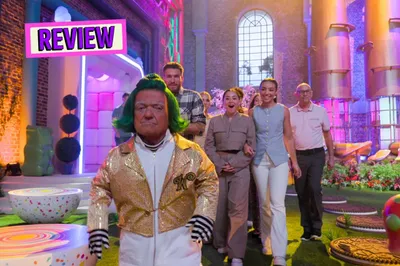
We didn’t even mention the Oompa Loompas, which come in a variety of heights this time but are led by veteran actor Rusty Goffe, who actually performed alongside Wilder in the 1971 film. He’s maybe the most authentic element in all of Wonka’s The Golden Ticket , which otherwise coasts on nostalgia while furthering AI’s grim invasion of every aspect of pop culture. Even with the Wilder family’s consent, it still feels a bit like Netflix is robbing his grave.
If you care to see who wins Wonka’s The Golden Ticket , the finale arrives September 30 on Netflix. But no matter who wins… well, we’ve already lost, haven’t we?
Want more io9 news? Check out the best movies and TV shows to stream this month and all the upcoming sci-fi, fantasy, and horror books that should be on your radar.