Our post-carbon future is already here—if you know where to look
This year has seen one environmental catastrophe after another. Collapsing glaciers triggered a devastating flood in Nepal , heat waves in Europe caused more than 35,000 deaths, and extreme temperature swings in the Midwest destroyed crops . “The climate alarm is blaring in every direction,” Simon Stiell, the executive secretary of UN Climate Change, said earlier this year . According to a recent report from the UN , the world is on course to cross the average warming level of 1.
This year has seen one environmental catastrophe after another. Collapsing glaciers triggered a devastating flood in Nepal , heat waves in Europe caused more than 35,000 deaths, and extreme temperature swings in the Midwest destroyed crops . “The climate alarm is blaring in every direction,” Simon Stiell, the executive secretary of UN Climate Change, said earlier this year .
According to a recent report from the UN , the world is on course to cross the average warming level of 1.5 degree Celsius (2.7 Fahrenheit) in the next few years. That’s considered a tipping point by the 2016 Paris Agreement, which called for net zero global carbon emissions by 2050.
[Photo: Building Postcarbon Futures: Land, Justice, and Energy Transitions]
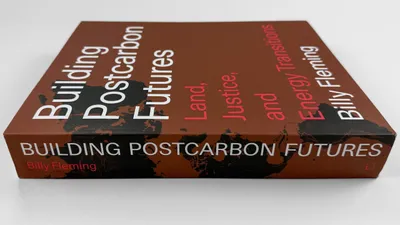
As dire as the headlines are, there are also reasons to be optimistic about addressing climate change. Dozens of them are listed in Building Postcarbon Futures: Land, Justice, and Energy Transitions , a new book by the landscape architect Billy Fleming. It turns out that we don’t have to look far for equitable, just, and environmentally sensitive solutions to decarbonization.
Fleming is an associate professor of landscape architecture at Temple University and an advisory board member of the Climate and Community Institute, and was a policy advisor to the Obama administration. In 26 case studies spanning 43 countries and six continents, he walks readers through proven ways that communities are addressing the challenge.
[Photo: Building Postcarbon Futures: Land, Justice, and Energy Transitions]
The atlas’s examples aren’t simply swapping conventional energy for green options; they challenge conventional ownership structures and what types of knowledge and innovation are prized. It isn’t always a race to the newest technique that matters, as demonstrated by the Zapatista movement’s milpa farming system in Chiapas, Mexico, which relies on techniques that date back 2,000 years. It also isn’t necessarily good design that is the most important outcome, as Lacaton & Vassal’s renovation of public housing in Bordeaux, France, demonstrated; the architects found ways to complete building retrofits, like new balconies and energy-efficient systems, without displacing residents.
We spoke with Fleming about the book, which he hopes becomes a reference for designers, policymakers, and everyday readers who are interested in learning more about solutions to the climate crisis.
This interview has been edited and condensed.
[Photo: Building Postcarbon Futures: Land, Justice, and Energy Transitions]
The book arrives at an interesting time. Year after year, we’ve faced more extreme environmental conditions. Here in New York, we’re now classified as a subtropical climate. How are you feeling these days about the movement toward a postcarbon future?
This book was a salve to work on for the last five or six years because, as bleak as it is today, it’s been like that for a long time in the environmental and climate justice movement. The unfortunate nature of doing that kind of work is we just often lose most of the things we’re fighting for. And when we win, we celebrate.
In some ways, the book is growing out of a frustration with the way my fields—designers broadly, planners, climate policy folks—tend to think about what a postcarbon future can or should look like, or what climate resilience actually is. Certainly in landscape architecture, architecture, and urban planning, the projects that tend to get valorized or foregrounded as exemplars of this kind of work are often really just ecological gentrification projects masquerading as some kind of huge win on climate action.
How did that shape the book’s content?
I wanted to look outside of our profession at people who are practicing architecture, landscape architecture, and urban planning, just without credentials. And to see what we might learn from places that have already started to figure some of this out, some at very small scale, some at very large scale. They’re building these imperfect works of climate justice that kind of show us what it can look like to flourish in a warmer, wetter world and have managed to do it, in some cases, in far harsher conditions than we live with in Philly or New York.
[Photo: Building Postcarbon Futures: Land, Justice, and Energy Transitions]
Can you share a little bit more about what a postcarbon future looks like to you? Reading the book, I was interested in how the examples included swimmable urban rivers, beautiful affordable housing, and even architectural salvage. Also, nothing was speculative.
I very intentionally did not want to dip into the realm of climate fiction, or design fiction more broadly. Not because I’m uninterested in it. I’m deeply interested in that and have my students working in those modes often in studios. But the intention of the book is we don’t have to turn to fiction to figure out what this can or perhaps even should look like. There are real existing exemplary works of postcarbon futures and climate justice all around us. We just don’t tend to look at them because they aren’t authored by big firms.
I think we can do things better. All of these projects are doing things better if imperfectly. They’re focused on how people flourish in a world that is hotter and wetter and more volatile. That begins, in some cases, with having stable, secure, and actually beautiful housing with lots of amenities connected to it. It sometimes includes owning and controlling and perhaps profiting from control of your own energy system, like the [Tu Deh-Kah geothermal energy plant in British Columbia owned by the] Fort Nelson First Nation. Sometimes it means operating a petrochemical-free agricultural or agroecology system that you developed because the U.S. and the West blockaded your country and tried to starve you to death. [Editor’s note: He’s referring to the organopónicos urban farming program in Cuba.] And now you’ve built enough power through food sovereignty that you can think about other things.
All of those are integral to a postcarbon future and climate justice. They just don’t always look like a piece of shiny technology or CLT [cross-laminated timber] being specced on a building.
Speaking of justice: Your thesis couples decarbonization with equity. Why was that interconnectedness important for you to foreground?
For a lot of reasons, one of which is this is not the first energy transition. There have been many, from steam, coal, gas, oil, and so on. This is one of many. There will be others after it. And in each of those, at least in the U.S., we’ve kind of reproduced or repeated the same pattern, which is we send tons of public subsidies and lubricate markets in order to create new private wealth that was made possible through mass public investment. Those things have made the planet worse, both ecologically and socially.
There are many, many other models for how we can invest in places and invest in people and invest in technologies and infrastructure without corroding society in the process. And so one of the ways that this book tries to kind of foreground what another path could look like is by showing projects where people actually own their energy infrastructure. They own or have real governance over their housing system. This idea of shared ownership is kind of implied. It’s not as overt as some other messages in the book, but the ability to control, own, profit from, and reinvest the proceeds of public investments in the energy infrastructure at a collective or cooperative scale is maybe the single most important thing in all of this.
[Photo: Building Postcarbon Futures: Land, Justice, and Energy Transitions]
There have been so many large-scale climate setbacks, especially involving the United States, which is the largest carbon contributor in history . Within the context of growing international conflicts, exiting the Paris Agreement, and really hitting the gas on data center construction, I did find reasons to be optimistic in some of these smaller-scale case studies. How do you square those two different scales of impact?
Windows always open and close, and local experiments are always where I think the best ideas get piloted. They get scaled in some cases to tremendous degrees. And then when a window for national or multinational transformation happens, we need lessons to be able to draw from quickly. That’s how I imagine many of these projects in the book hopefully working. These are the building blocks of what a future postcarbon or climate justice program could draw upon the next time we get a chance to push things through.
This is what many of us were doing in 2018, 2017 around the Green New Deal during Trump I. What is the program we can push forward the next time we get a window to do so? I don’t want to pretend like that was wildly successful, but there were a number of provisions in both Biden’s IRA [Inflation Reduction Act, promoting clean energy] and a number of other state- and local-level programs that came directly out of that work.
One, which is still growing, is [Pennsylvania state senator] Nikil Saval’s Whole-Home Repairs Act , which we got to work on with him. It’s incredible. It retrains low-income workers to do deep weatherization and deep energy retrofits in low-income communities throughout Pennsylvania. It’s been wildly successful. Its funding has increased every year since it’s been on the books. Now it just got a national pilot in the big housing bill that just passed a month or two ago.
That work comes out of this very local experiment that Saval, somehow, got an oil-and-gas-owned Republican legislature to sign off on in Pennsylvania and now has a chance to put a bunch of people who need good jobs back to work in their communities doing the kind of unsexy deep weatherization or deep energy retrofit work in communities that would otherwise never get.
[Photo: Building Postcarbon Futures: Land, Justice, and Energy Transitions]
I wanted to go back to some of your criticism of the design profession. Where do you see capital-D designers within the context of postcarbon futures? How can they best use their power given the prevailing economic, political, and social systems?
I don’t want to pretend like it’s easy to run a firm and to try and make payroll and keep the lights on and do all of the things that your increasingly radical workforce is asking you to do.
But I think there’s a very real risk for landscape architecture, in particular—but we could say architecture and urban planning as well—driving a generation of very talented and very committed workers out of the field because they find themselves in offices where they expect to work on the kinds of things maybe that are foregrounded in this book and they find themselves working primarily on, in a best case scenario, maybe beautiful things for rich people. And in a worst case scenario, pipelines, prisons, and all of the other things that actually float the A&E [architecture and engineering] industry.
The most interesting practices to me are finding ways to do low-carbon, capacity building work. They’re places like [the Los Angeles–based landscape firm] Terremoto who are looking at how we treat investments in gardening and in small-scale landscape interventions as a way to pilot both different types of approaches to land stewardship as a way to build ecological knowledge amongst a larger group of people, and as a way to build social cohesion. Ruderal , Sarah Cowles’s practice in Georgia, and Wagon , in France, or other landscape offices do this work really well.
The whole idea is we do small moves, we work in very low-capital intensive ways with what’s on site, and we treat this as a place for people and ecological knowledge to be developed and for capacity to grow over time.
If I were graduating and thinking about where I would want to work, I’d want to go to a place-based or regional-based office with deep commitments to particular groups and communities and people who want to build slow projects over time that aren’t taking them into the same capital chasing that McKinsey and AECOM do.
Lastly, who do you hope reads the atlas and what do you hope they take away from it?
The wrong answer is probably everyone. I intentionally thought of the atlas and the case study approach to the book as useful for practitioners who are looking for an alternative set of references. I hope it’s useful to people in the climate policy world who are often thinking and talking in really abstract ways about how to decarbonize, how to build social justice, but in ways that don’t feel tangible or visceral or real. I think the most successful version of climate policy that I would expect people to maybe get excited about is one that they can touch and they can feel and they can see themselves and the people they love within.