Iranian president accuses US and Israel of violating international law at the UN
Tehran is ‘ready for dialogue and diplomacy and negotiations without accepting the language of force,’ Masoud Pezeshkian said in his address to world leaders
 Peace Deal Drama$PDD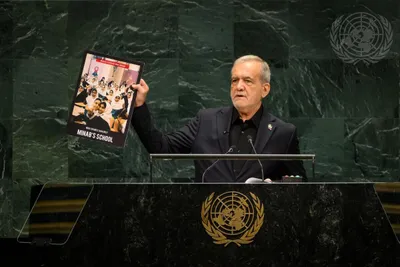
Washington’s threats will only unite Iran, and the country will not surrender in the war with the United States, but it is willing to explore a diplomatic solution to the conflict. So said a defiant Iranian president, Masoud Pezeshkian, in his speech to the UN General Assembly, a day after President Donald Trump threatened to “annihilate” Tehran if a peace agreement was not reached in his own address to world leaders on Tuesday.
Tehran’s representative accused Washington and Israel of acting “against international law” by striking civilian infrastructure in Iran, in a speech illustrated with photos of children killed at the Minab school bombed at the start of the war. It was the first time a leader of a country at war with the United States had addressed the United Nations General Assembly, which is headquartered in New York. Pezeshkian, who seven months ago was sheltering from bombs in a bunker, is traveling under Secret Service protection at the assembly, like the other leaders attending the annual summit of heads of state from the UN’s 193 member countries.
Over roughly 25 minutes of remarks, the Iranian president described the attacks by Israel and the United States as “terrorism” in a war about to reach the seven-month mark with no end in sight. Behind the scenes, however, diplomatic contacts continue: Iranian foreign minister Abbas Araghchi met with U.S. representatives Steve Witkoff and Jared Kushner, Trump’s son-in-law, for three hours on the margins of the General Assembly on Tuesday.
The two sides are scheduled to meet again “in the near future,” according to Trump. Iran is “ready for dialogue,” Pezeshkian emphasized in his address, in which he painted, or attempted to paint, an image of an irreducible Islamic Republic that the bombs have not been able to make yield, and have no prospect of doing so. “[Trump] must know that the resistance of the Iranian people will only increase in the face of sanctions, increased pressure, increased bullying,” the Iranian head of state said.
“Iran must be understood by Mr. Trump and those who seek to bully us that we are ready for dialogue and diplomacy and negotiations without accepting the language of force.” The Iranian president also said his country would press ahead with its nuclear program: “We say it clearly: No nuclear weapons and no limitations to peaceful nuclear technology.” “The United States and Israel attacked us with the latest technology and equipment, and our people stood firm and fought back,” the representative of the Islamic Republic declared, saying he had revised his remarks after Trump labeled Tehran the “number one sponsor of terror” on Tuesday in his own speech.
“We did not bend the knee; we did not bow our heads. We responded, but we did not hit civilian populations.” In an especially dramatic moment in his roughly 15-minute speech, Pezeshkian held up photographs of the children killed at the Shajareh Tayyebeh primary school in Minab by U.S. missile strikes launched on the day the war began, February 28. That bombing killed 150 people, most of them schoolchildren. The episode has become a symbol inside Iran of the atrocities of the U.S. and Israeli attacks.
“They martyred, assassinated our scientists, our men, women and children — innocent children whom, in truth, had committed no crimes, no sins,” the Iranian president said. In response, the U.S. representative present in the chamber stood up and left the room. A UN report found last week that the United States may have committed war crimes when it launched its initial strikes against Iran, including the bombing of the Minab school.
The Trump administration flatly denies this. Iran, which received travel authorization for a small delegation during the opening of the General Assembly, is using its presence at UN headquarters to pursue intensive diplomatic activity. Despite Trump’s Tuesday appeals to other nations to join the U.S. campaign to try to economically isolate Tehran, on Tuesday Araghchi met with his counterparts from the United Kingdom, Italy, Austria, Qatar, and Azerbaijan, as well as the European Union’s foreign policy representative, Kaja Kallas.
And, through intermediaries, he spoke with Witkoff and Kushner. “Today, on the sidelines of the United Nations General Assembly, we engaged in lengthy talks with the Iranian delegation through the mediators, who shuttled between the two sides throughout the day,” Witkoff wrote on X on Tuesday. The billionaire, a personal friend of Trump and the administration’s special envoy for conflicts, expressed hope that the contacts “will prove constructive and promising.
The mediators will continue their work.” Iran, for its part, said through its spokesman, Esmail Baghaei, that in those talks it demanded an end to the war and to the blockade the United States is imposing on Iranian ports in the Strait of Hormuz area. In his speech, Pezeshkian also referred to the Strait of Hormuz, the strategic maritime channel through which, before the war began, one-fifth of the world’s oil and liquefied natural gas passed, the closure of which has become central to the war.
“It cannot be the case that everyone benefits from the Strait of Hormuz while we are denied access to shipping through this waterway. The permanent deployment of hostile fleets and the expansion of the war will not lead to peace,” the Iranian president warned. Sign up for our weekly newsletter to get more English-language news coverage from EL PAÍS USA Edition