India-New Zealand FTA: New Zealand Parliament passes legislation, what New Delhi gains from trade deal?
New Zealand expects the deal to come into effect this year, after both parties complete their ratification procedures, according to Trade and Investment Minister Todd McClay.
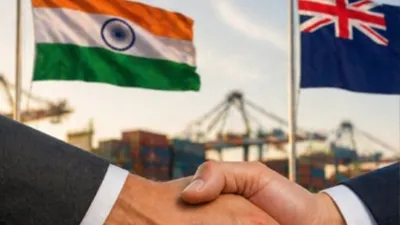
New Zealand expects the deal to come into effect this year, after both parties complete their ratification procedures, according to Trade and Investment Minister Todd McClay.
Updated : Sep 16, 2026, 12:02 PM IST
India-New Zealand free trade agreement gets a boost as New Zealand's Parliament passed the legislation, paving the way for tariffs on about 95 per cent of New Zealand exports to India to be eliminated or significantly reduced. The Bill was passed by 93 votes to 29, with opposition Labour support.
The FTA was signed between India and New Zealand in April. "Once fully implemented, tariffs are eliminated or significantly reduced on 95% of our exports," Trade and Investment Minister Todd McClay said in a statement. The deal also includes faster border clearance and preferential access "to a fast-growing middle class that is demanding high-quality food, fibre, technology, education, tourism and professional services," he noted.
New Zealand expects the deal to come into effect this year, after both parties complete their ratification procedures, according to McClay.
With implementation, New Zealand's 57 per cent of exports to India will be duty-free from day one, while tariffs on about 95 per cent of exports will be reduced significantly. Wellington has also agreed to invest NZ$20 billion (around Rs 1 lakh crore) in India over the next 15 years. The agreement also provides for improved market access and trade facilitation, with New Zealand identifying opportunities in areas including food, technology, education, tourism and professional services.
The FTA framework encompasses market access, agricultural productivity, investment, talent mobility, collaboration in sports, tourism, and people-to-people ties. It is designed to benefit manufacturers, farmers, MSMEs, women entrepreneurs, students, and skilled professionals across both nations. Under the framework, India has offered market access on 70.03% of tariff lines, covering 95% of bilateral trade, while keeping 29.97% in exclusion.
The market access includes sensitive sectors such as dairy, several agricultural products, sugar, arms and ammunition, and select metals. 30% of tariff lines will see immediate duty elimination, while another 35.60% will be phased out over 3–10 years; 4.37% will see tariff reductions, and 0.06% will be covered under tariff-rate quotas for products such as Mānuka honey, apples, kiwifruit and albumins.
Currently, New Zealand is India’s second-largest trading partner in Oceania. Bilateral merchandise trade rose 49% from USD 873 million in 2023–24 to USD 1.3 billion in 2024–25. India’s exports to New Zealand increased 32% to USD 711 million, while services exports reached USD 634 million in 2024, led by travel, IT and business services. Over the past decade, bilateral merchandise trade rose from USD 855 million in 2015–16 to USD 1.298 billion in 2024–25, with Indian exports growing 130%. India maintained a positive trade balance with New Zealand in 2024–25, according to govt data.
For India, the FTA opens opportunities for India to emerge as a key supplier of skilled workforce, alongside prospects to boost MSMEs, employment and competitiveness in labour-intensive sectors such as textiles, leather, footwear, gems and jewellery, engineering goods and processed foods. India will also get duty-free access to key manufacturing inputs such as wooden logs, coking coal and metal waste, helping lower production costs and integrate Indian businesses into global value chains.
In agriculture, India and New Zealand will cooperate on kiwifruit, apples and honey through Centres of Excellence, improved planting material, research, technical support and better post-harvest practices to raise productivity and farmer incomes. At the same time, market access for New Zealand’s apples, kiwifruit, Manuka honey and albumins will be managed through tariff-rate quotas, minimum import prices and seasonal imports, along with productivity action plans and monitoring to protect sensitive domestic agricultural sectors.
State-wise, the gain will be expected in sectors from textiles and engineering in Tamil Nadu and Uttar Pradesh to pharmaceuticals in Maharashtra, Telangana and Himachal Pradesh, marine products in Andhra Pradesh, Kerala and Odisha, gems and jewellery in Gujarat and Rajasthan, and agriculture, handicrafts and MSMEs across several states, potentially supporting exports, employment and greater integration into global value chains.