Trump–Xi Summit 2.0: What it means for Nigeria
What the summit is about Donald Trump and Xi Jinping meet in Washington on 24 September 2026, their second meeting read more Trump–Xi Summit 2.0: What it means for Nigeria
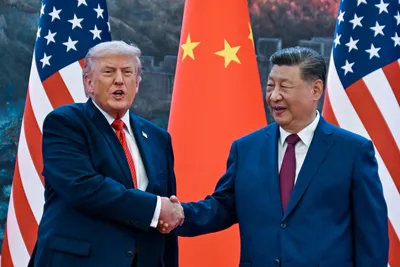
US President Donald Trump (R) shakes hands with China's President Xi Jinping at the Great Hall of the People in Beijing on May 14, 2026. (Photo by Kenny HOLSTON / POOL / AFP via Getty Images)
What the summit is about
Donald Trump and Xi Jinping meet in Washington on 24 September 2026, their second meeting of the year after Trump’s May visit to Beijing. The existing US–China trade truce expires 10 November 2026, making this the last major checkpoint before businesses lock in supply-chain and pricing decisions for 2027. The core question is whether the truce is extended or another tariff round begins; tariffs on some goods exceeded 100% during the earlier escalation.
China enters the meeting from a position of strength. In August 2026, Chinese exports rose 25% year-on-year and imports rose 28.2%, producing a monthly goods surplus of $119.1 billion and a January–August surplus of $805.5 billion. The US wants greater market access and a smaller trade imbalance; China wants certainty for its exporters and fewer restrictions on technology and critical minerals. A truce extensio, not a dramatic new deal, is the realistic outcome, and it would matter by giving businesses cost and supply-chain certainty.
Nigeria’s Q2 2026 trade report — The numbers
The National Bureau of Statistics’ Q2 2026 Foreign Trade report gives the clearest picture of how exposed Nigeria already is to swings in global trade. Total merchandise trade reached N41.44 trillion, up 19.13% from Q1 2026’s N34.79 trillion, producing a trade surplus of N12.60 trillion, more than double the prior quarter’s surplus.
ads
ads
Crude oil still dominates the export book: crude accounted for N12.91 trillion (47.79%) of exports, non-crude oil products N14.10 trillion (38.41%), and non-oil products only N3.72 trillion (13.80%), underlining how little Nigeria has diversified away from oil despite years of policy statements to that effect.
China alone supplied 41.02% of Nigeria’s Q2 2026 imports, more than the next four countries combined, while the US absorbed only 6.40% of Nigeria’s exports but supplied 6.97% of its imports and remains a key source of investment and technology. This asymmetry is exactly why a US–China trade shock transmits so directly into Nigeria: on the import side through China, and on the revenue side through oil and the US-anchored dollar system.
ads
ads
A double-edged sword for Nigeria
A calmer US–China relationship reduces pressure on Chinese exporters to reroute goods or raise prices abruptly, helping keep machinery, electronics, solar equipment and vehicles relatively affordable for Nigerian buyers. If US tariffs instead stay elevated, Chinese producers may redirect even more output toward Africa, pushing import prices lower still, a net gain for Nigerian consumers and import-dependent businesses.
But the same redirected exports squeeze Nigerian manufacturers competing on price, complicating the country’s push to deepen domestic industry. Nigeria’s own energy transition illustrates the dependency: local solar-panel assembly capacity has grown from 120MW to 300MW in two years, but most equipment is still imported from China, tying a strategic sector directly to the outcome in Washington.
Oil, reserves and the Naira
China is one of the world’s largest commodity consumers, so a deterioration in US–China trade can slow global growth and soften oil demand, squeezing Nigeria’s export earnings, given crude still makes up 47.79% of exports. As of early September 2026, the naira was trading around N1,329/$ on the NAFEM window and external reserves stood near $54.6 billion, their highest level in about 18 years, supported by stronger oil earnings, diaspora remittances and sovereign bond issuance. That buffer gives Nigeria more room to absorb a moderate trade shock than it had going into the 2023–2024 devaluation, but it does not make the naira immune to a sharp swing in global risk sentiment or oil prices.
• NSIA’s $300m fund targets Nigeria’s untapped energy market
• Three market wins in nine days as election cycle nears
• Over 4,500 schools, 8,000 communities at risk of flooding, agency reports
The AI front
Advanced chips and AI infrastructure are now bargaining chips in the US–China relationship: Washington restricts Beijing’s access to advanced semiconductors, while China controls key mineral supply chains that AI hardware depends on. For Nigeria’s growing fintech, telecoms and AI-adoption drive, tighter restrictions could raise the cost of cloud and computing access; sharper rivalry could equally push both powers to court markets like Africa’s. The scale of the prize is large, the WTO estimates AI could raise global trade by up to 40% by 2040, concentrated in digitally deliverable services.
The cost of a divided world
Beyond trade numbers, the summit is about managing a rivalry between two superpowers; Taiwan, critical minerals and tech access remain flashpoints, and most analysts expect it to stabilize rather than resolve that rivalry. This matters for Nigeria because fragmentation is expensive: the WTO estimates a world split into geopolitical trade blocs could shrink global GDP by 5.1% and global exports by 18.6% relative to a more integrated system. Nigeria’s interest lies in a world where major economies keep trading across blocs rather than forcing smaller economies to pick a side.
Outlook: Q3 2026 – 2027
Combining the summit calendar with current IMF growth projections and oil-price forecasts points to a cautiously stable near term for Nigeria, with the main risk concentrated around the November truce deadline and the 2027 oil-price path.
2027 Oil-price downside is the biggest single risk to the naira
The IMF projects Nigeria’s GDP growth accelerating to 4.3% in 2027 (from 4.1% in 2026), citing improved macro stability and favourable terms of trade. The larger risk is oil: JPMorgan expects Brent to revert toward a $60/bbl regime from the second half of 2027 as global supply recovers, a level that would materially cut Nigeria’s dollar earnings and test the reserve buffer built up in 2026, unless non-oil exports (currently just 13.8% of the total) have genuinely grown by then. Nigeria’s ability to convert 2026’s trade surplus and reserve gains into lasting diversification, rather than a one-off oil-and-China-driven bounce, is the central question for 2027.
What to watch
1 Truce extension past Nov 10 — Determines tariff/price stability for Chinese goods reaching Nigeria
2 Chinese export redirection — More redirection to Africa = cheaper imports, but tougher local competition
3 Critical minerals / rare earths — Signals how far tech and supply-chain tensions will spread
4 AI chip restrictions — Affects cost of cloud/computing infrastructure Nigeria’s tech sector relies on
5 Brent crude price path — Directly drives 47.79% of Nigeria’s export revenue and the naira
6 Nigerian import prices — Tracks pass-through of Chinese trade conditions to consumers
7 Non-oil export share — The real test of diversification heading into 2027
Share
Join BusinessDay whatsapp Channel, to stay up to date