Socialist-run Lleida bans burqa and niqab in public with Junts and Vox votes
Lleida's city council has approved a ban on face-covering garments like the burqa and niqab in public spaces, aiming to promote civic behaviour and women's rights. Source
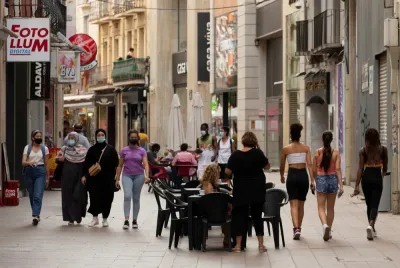
The city council of Lleida, in Catalonia, has approved a ban on wearing garments that fully conceal the face in public spaces, including the burqa and the niqab.
The measure, part of a new civic behaviour and coexistence ordinance replacing rules in force since 2007, passed on September 25 with 16 votes in favour. Backing came from the governing Socialists’ Party of Catalonia (PSC), Together for Catalonia (Junts) and Vox, while the People’s Party (PP), Republican Left of Catalonia (ERC) and the left-wing Comú de Lleida voted against.
Article 12 of the text does not name either garment. It prohibits any clothing that prevents identification by covering the face entirely and classes breaches as minor offences, punishable by fines of €400 to €750 (about $455 to $853).
Places of worship are exempt, as are settings where covering the face is an accepted social custom, such as festivities, and cases involving the exercise of a fundamental right. The ordinance has only initial approval and must still complete its administrative procedure.
The council, led by Socialist Mayor Fèlix Larrosa, defended the veto on grounds of civic behaviour and women’s rights rather than public security. Council officials said the aim was to prevent women from being isolated from city life.
The city has been here before. In 2010, Lleida became the first Spanish city to bar full-face veils in municipal buildings, only for the Supreme Court to annul the rule in February 2013 on the grounds that limits on religious freedom could be imposed only by law.
Junts, whose five councillors proved decisive, had 31 of its 55 amendments accepted. One subjects the ban to current legislation in anticipation of possible national rules, and the party also made its support conditional on a motion to install public toilets and showers.
The PP opposed the text from the right, having tabled 76 amendments. It argued that the exemptions meant the ordinance permitted and regulated face veils rather than banning them, while ERC and Comú criticised it as punitive.
The vote came seven months after Spain’s Congress threw out a Vox bill for a nationwide ban, registered in November 2025 with the backing of the PP. It fell on February 17 by 177 votes to 170.
Junts voted against that text, distancing itself from Vox, and registered its own bill that would also hand Catalonia powers over security and personal identification.
Several European Union member states already outlaw face veils in public, including France, Belgium, Denmark and Austria. Portugal joined them in August when its President signed a bill from the right-wing Chega party.
Italy’s Government banned the burqa and niqab in schools by decree on September 24.