Indonesians look to Saudi Arabia for stronger education, energy partnerships
JAKARTA: Indonesians are hoping closer ties with Saudi Arabia will strengthen energy partnerships and bring more opportunities in the education sector, as they took part in celebrations to commemorate the Kingdom’s 96th National Day in Jakarta. Saudi-Indonesian ties span centuries but reached new highs in recent years, with Crown Prince Mohammed bin Salman and President Prabowo Subianto agreeing to strengthen strategic cooperation in 2025. Major deals between governments and businesses have be
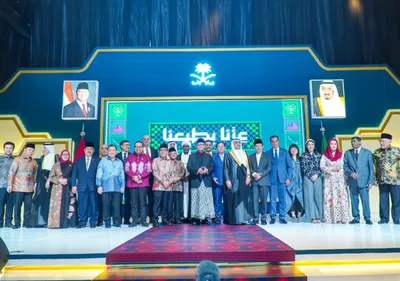
JAKARTA: Indonesians are hoping closer ties with Saudi Arabia will strengthen energy partnerships and bring more opportunities in the education sector, as they took part in celebrations to commemorate the Kingdom’s 96th National Day in Jakarta.
Saudi-Indonesian ties span centuries but reached new highs in recent years, with Crown Prince Mohammed bin Salman and President Prabowo Subianto agreeing to strengthen strategic cooperation in 2025.
Major deals between governments and businesses have been signed since, while senior Saudi and Indonesian officials also exchanged visits aimed at boosting ties, including a recent trip by Saudi Education Minister Yousef bin Abdullah Al-Benyan to Jakarta earlier this month.
“The strength of Indonesia-Saudi Arabia relation lies in the strength of our partnership and in the trust that has been built between our peoples over many years,” Minister of Hajj and Umrah Mochamad Irfan Yusuf said in his speech at the Saudi National Day event on Wednesday.
“From Hajj and Umrah to trade, investment, tourism, and new areas of economic cooperation, we have a strong foundation upon which to build an even closer partnership. Indonesia looks forward to continuing our close cooperation with the Kingdom of Saudi Arabia.”
Yusuf, who was the chief guest during the occasion, attended alongside other Indonesian officials, including Religious Affairs Minister Nasaruddin Umar, Minister of Primary and Secondary Education Abdul Mu’ti, and Minister of Women's Empowerment and Child Protection Arifah Fauzi.
Their attendance “confirmed the extraordinary ties” between Indonesia and Saudi Arabia, said Faisal Abdullah Amodi, the Kingdom’s ambassador to Indonesia.
“What we witnessed during the event is surely a reflection … of the aim to strengthen cooperation in various levels and areas; a cooperation headed toward a more strategic direction,” he told reporters.
Saudi-Indonesia ties have been on the rise in recent years. This includes trade, which was valued at $6.53 billion last year, and major renewable energy deals.
Indonesians who attended the National Day ceremony told Arab News they see opportunities for even closer collaborations across different areas.
In the energy sector, Jakarta-based professional Suparlan sees the Kingdom as a “strategic partner.”
“Indonesia is currently developing its energy sector — with the aim of achieving energy security,” he said.
“Since Saudi Arabia is more advanced in this area, investment will improve even further as the relationship between the two countries strengthens.”
Recent developments in the Kingdom, including projects related to Saudi Vision 2030 that touches upon emerging areas including technology, also offer opportunities for Indonesia.
“Saudi Arabia has been developing areas beyond religion, such as technology and other things, yet there are not that many Indonesians who are keen to pursue non-religion studies (in Saudi Arabia). But I think this is an opportunity that the two countries should explore,” said Ganefri, a senior executive at the State University of Padang.
For Ai Fatimah Nur Fuad, a professor of Islamic studies at Universitas Muhammadiyah Prof. Dr. Hamka in Jakarta, there is potential for collaboration in academia.
Her vision is in line with official talks that took place during the Saudi education minister’s trip to Indonesia last month, when both countries agreed to strengthen cooperation, including scholarships, research and development, and the utilization of digital technology and artificial intelligence in the sector.
According to Fuad, Saudi and Indonesian scholars can collaborate to publish work on contemporary socio-religious issues in Arabic.
“This is important, because though Arabic is used widely as a spoken language, it still lags behind in terms of academic productivity, behind English-language journals and academic research articles,” Fuad told Arab News.
“Since knowledge transcends geographical and political boundaries, educational collaboration like faculty and student exchanges, is highly feasible … The collaboration between Indonesia and Saudi Arabia could yield a significant impact in the academic field, alongside its Islamic and spiritual significance.”