China watchers split on what a Trump-Xi summit will deliver
US President Donald Trump and Chinese President Xi Jinping are set for a highly anticipated summit in Washington. Some see the meeting as an opportunity to stabilise relations, while others caution that the carefully choreographed encounter could amount to little more than political theatre.
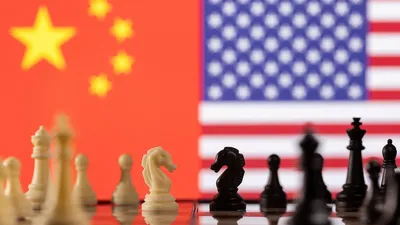
Tariffs, rare earths, technology and agricultural trade are on the agenda for this week's Washington summit. ( Reuters: Evan Vucci )
This week's Washington summit brings together the world's most powerful leaders, Xi Jinping and Donald Trump, face to face at a time of deep strategic and economic rivalry.
The summit, which marks the Chinese president's first state visit to the US in 11 years, is expected to have artificial intelligence (AI), tariffs, rare earths, technology, and agricultural trade high on the agenda.
Mr Xi is scheduled to arrive Wednesday afternoon local time (Thursday morning in Australia) at Joint Base Andrews, where Mr Trump will personally greet him on the tarmac.
The three-day visit will include ceremonial events alongside the bilateral talks, including an arrival ceremony on the White House South Lawn, a military review in the Rose Garden, a state dinner and a visit to the National Archives.
Officials from both countries say they have made progress on AI and trade issues ahead of the meeting, but China watchers remain divided over what the talks will ultimately deliver.
Some see the meeting as an opportunity to stabilise relations, while others caution that the carefully choreographed encounter could amount to little more than political theatre.
Scott Kennedy, from the Center for Strategic and International Studies based in Washington, DC, said the most likely outcome was an extension of the trade ceasefire struck at the Busan summit in October 2025, due to expire on November 10.
US Treasury Secretary Scott Bessent and Chinese Vice-Premier He Lifeng met in New York, ahead of the US-China leaders' summit. ( Reuters: Vincent Alban )
That deal saw China commit to continuing rare earth exports in exchange for a cap on US tariffs.
Mr Kennedy said he expected some agreements on specific goods, such as agricultural products and Boeing aircraft, building on commitments made when Mr Trump visited Beijing in May.
But he did not think it would shift the broader "stand-off", which he believed favours Beijing.
Scott Kennedy predicts the visit will be largely "theatre". ( Supplied: CSIS )
Mr Kennedy said Mr Trump in May effectively conceded to wind back arms sales to Taiwan, putting Washington at a disadvantage.
"I think China has got the most important things it's sought already — defence against potential re-escalation by the United States, and some progress on cross-strait issues in Taiwan," he said.
"So I don't see the US being able to wrangle any large concessions out of China on any big issues for the rest of the year.
The South China Morning Post reported on Saturday that the US was considering delaying the announcement of major Taiwan arms sales until after November's APEC summit in Shenzhen and December's G20 summit in Miami.
Mr Trump has repeatedly told reporters he got along well with Mr Xi, and he expected a "very good meeting" at the White House this week.
However, Orville Schell, who travelled with Mr Trump to Beijing in May, observed a distinct difference in warmth between the two leaders.
Orville Schell believes Trump and Xi lack rapport. ( Supplied: Asia Society )
"At first, Mr Trump was very sort of flattering Mr Xi in a very obsequious, fawning way — almost as if he was supplicating him, almost begging him to be nice," said Professor Schell, the director of the Asia Society's Center on US-China Relations.
"Xi Jinping certainly didn't respond in a reciprocating manner … Xi just sat there like a statue."
In an article for Foreign Affairs earlier this month, Professor Schell wrote: "Trump and Xi can't stop the US-China spiral", as deep mutual mistrust made a breakthrough unlikely.
"I don't think there's an awful lot of common ground these men could come to terms on … I don't think Xi would buy it easily from any American president because he doubts the intentions," he told the ABC.
He added that Mr Xi was unlikely to make compromises "fearing concessions could be perceived as a form of weakness".
Donald Trump met Xi Jinping in Beijing in May this year, the US president's first visit to China during his second term. ( Kenny Holston/Pool via Reuters, file )
Chinese experts, meanwhile, have expressed some optimism about the upcoming leaders' meeting.
Wu Xinbo, director of the Center for American Studies at Fudan University in Shanghai, said he expected the two leaders to reaffirm the "constructive relationship of strategic stability" that Beijing coined in May.
Wu Xinbo says he is cautiously optimistic about the upcoming summit. ( Supplied: Fudan Uni )
He said the two sides hoped for progress on military-to-military exchanges and a regular AI dialogue mechanism.
Following Mr Trump's visit to China, a spokesperson for China's Ministry of National Defense said the two sides would "strengthen communication and dialogue".
"I remain cautiously optimistic," Dr Wu said.
"As long as leader-level diplomacy between China and the United States continues to move forward, I think bilateral relations can maintain a trajectory of stability with some progress."
Dr Wu said he believed Beijing's two priorities were deepening regional cooperation and Global South engagement on one hand and managing the US relationship on the other.
"If China-US trade and economic relations can stabilise, I think that would send a very positive signal to the markets."
The summit comes as international polling suggests a broader shift in global sentiment.
The Pew Research Center's Global Attitudes Survey found a median of 51 per cent across countries tracked hold a favourable view of China, against 49 per cent for the US — the first time China has out-scored the US in roughly two decades of Pew polling.
Many experts believe a trade truce between the world's two largest economies could bring stability. ( Reuters: Tingshu Wang, file )
The latest Lowy Institute Poll showed Australians' warmth toward China up 9 degrees on Lowy's "feelings thermometer" since 2021, while warmth toward the US had dropped 13 degrees since 2024.
And the ISEAS-Yusof Ishak Institute's State of Southeast Asia Survey found the region swinging back toward China as its preferred power, reversing a brief US-favoured shift in 2025.
Wei Zongyou from Fudan University said China's steady, non-confrontational approach, which he described as "you fight your way, I'll fight mine", was working in Beijing's favour.
"This shows that, after decades of development, China now has that confidence in itself," he said.
"The US side cannot expect to prevent China's development simply by suppression or containment."
Wei Zongyou says China's strategy toward the US is working well. ( Supplied: Fudan Uni )
Dr Wei said Mr Trump's approach had also strained relationships with US allies.
"That has left many of those allies deeply disillusioned."